
Parallax: tracking every object out to the Moon
Parallax is a space domain awareness company: its satellites and ground stations watch the space between Earth and the Moon, and where two lines of sight cross on an object is a fix. We designed the name and mark, the Witness satellite, the Custody console and its phone app, and a one-page capability brief.
- Project
- An Alterra Studio project
- Stage
- Space domain awareness, pre-launch
- Services
- Naming, logo, the Custody console, the phone app, capability brief, 3D satellite, posters
Tracking objects out to the Moon
Parallax tracks objects out to the Moon with 24 small satellites and two laser stations.
lunar missions planned by space agencies and companies in the next two decades.
Source: ESA, 2024
went into defense-tech venture deals in 2025, a record.
of eight missions the Space Force wants industry to fill: space domain awareness.
Source: Air & Space Forces, 2024
Technical notes
- Space surveillance networks track about 40,000 objects, some 11,000 of them active payloads (ESA Space Environment Report, 2025).
- Cislunar space covers 1,728 times the volume inside geosynchronous orbit (The War Zone, 2021).
- The Space Force plans its first reserve contracts for commercial space domain awareness in 2026 (DefenseScoop, 2026). Defense-tech venture deals were $27.2B in 2024, before the 2025 record (Defense News, 2026).
Two lines of sight make a fix
The one idea behind the product: where two lines of sight cross is a fix.
LTO-4471 · lunar transfer
Out of custody
412km
uncertainty along the track
- Angle between the lines of sight
- 1.2°
- Lines of sight
- 2
- Custody limit
- 10 km
Drag the Witness around the object. The closer the angle gets to 90 degrees, the smaller the error.
Technical notes
- The same crossing gave Parallax its name, its mark and its product.
- A telescope makes an angles-only observation: two angles on the sky and a time, with no distance. One sensor gives a bearing. A second sensor far away gives the place.
- For two sensors of similar accuracy, the error is smallest and closest to round near 90 degrees. Engineers call this geometric dilution of precision. At 10 degrees the same pointing error stretches the fix about eight times longer than at 90.
- Custody tasks the pair with the widest angle: 89.4 degrees for LTO-4471.
Two sensors see one spent stage
Evaluators see the whole system work in space before a single satellite launches.
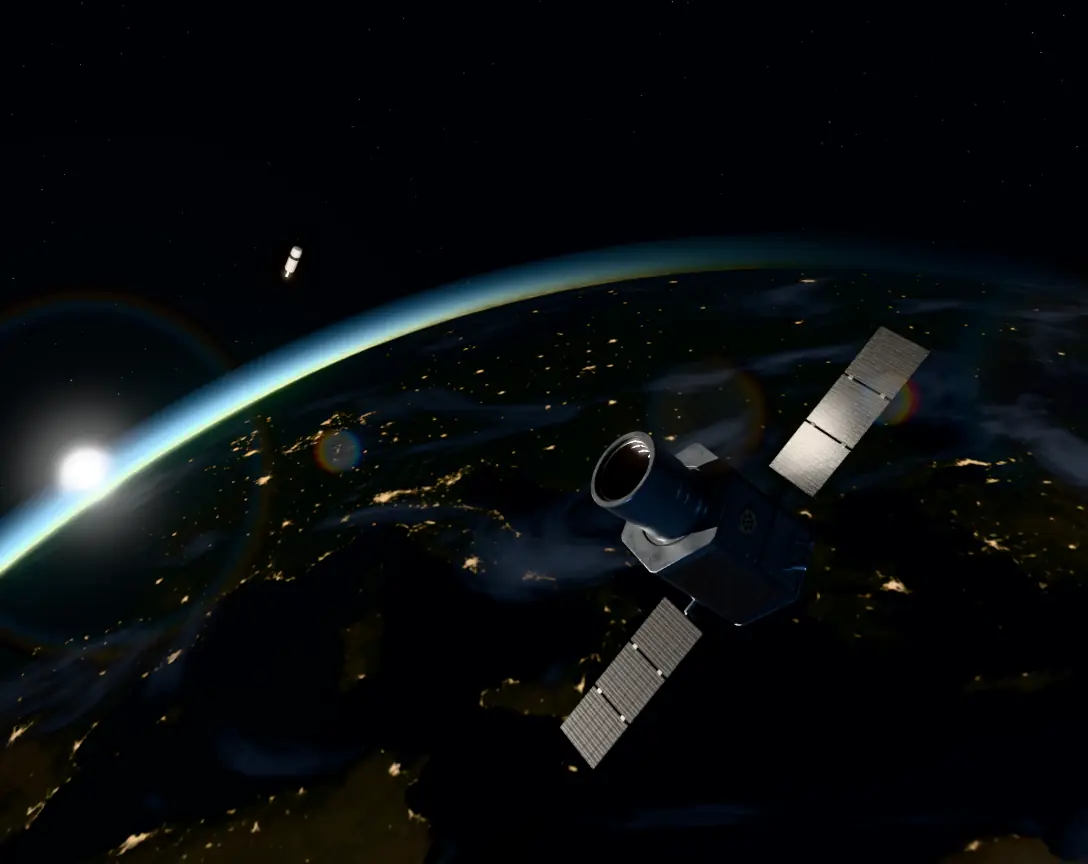
- 01One satellite sees the object's direction, not its distance.
- 02A station on the ground sees it from a second, very different angle.
- 03Where the two lines cross is where the stage is. That is a fix.
- 04Each new sighting adds a dot to its track.
Technical notes
- Scroll to draw two lines of sight, from PX-07 in orbit and Station South on the ground, to one spent stage.
- Past geosynchronous orbit, 36,000 km up, objects are seen from a narrow range of angles, away from the Moon's and the Sun's glare, and both bodies pull on them (Greaves and Scheeres, AMOS 2021).
- Ground stations range every Witness by laser, so each line of sight starts at a known point (NASA Earthdata).
- Six steps: sense, locate the sensors, fit the orbit, judge custody, act, hand off.
The watch floor, from alert to handoff
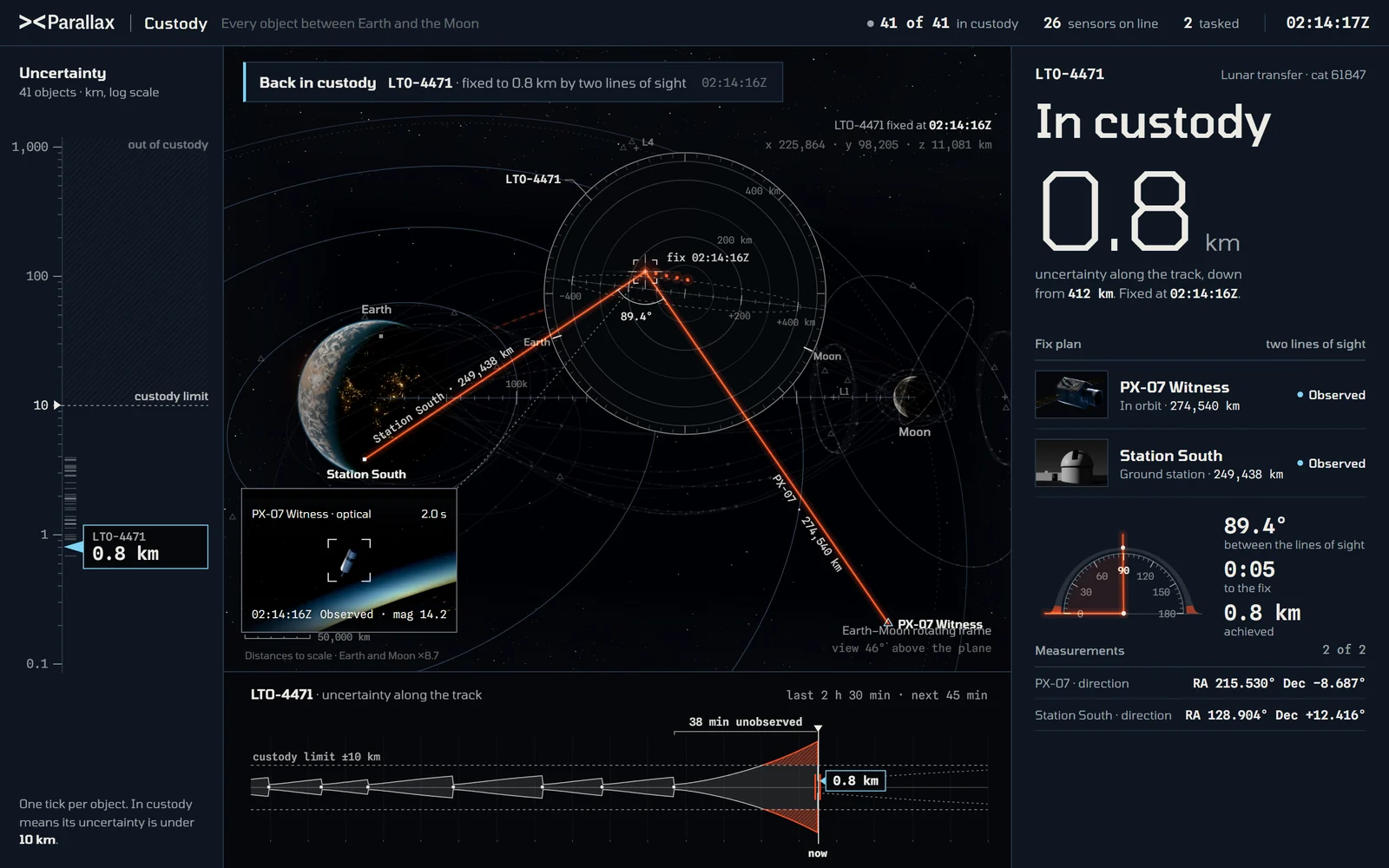
The console takes an operator from a lost object to a fix and a handoff, even at three in the morning.
Technical notes
- Each screen shows one state, like Out of custody, and one number: how many kilometres off the object could be.
- An object is in custody while its uncertainty stays under 10 km.
- Doubt grows fastest along the track: a small error in speed puts the object further ahead of or behind its predicted place every minute (Jones and Beckerman, AAS 1999). LTO-4471 went 38 minutes unobserved, and its doubt grew to 412 km.
- The residual plot shows each observation at its distance from the predicted track. Good ones sit under 3.2 km, the 3-sigma line. Station North's last one is 160 km off: the object has changed its orbit.
The duty officer's phone
The duty officer approves a fix from the Lock Screen, away from the watch floor.
Hold to get a fix
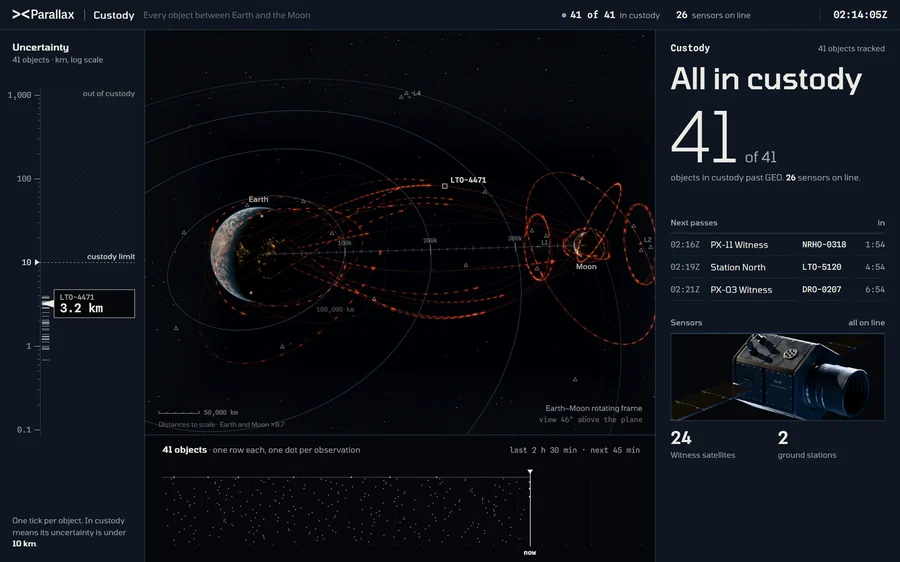
1 of 6On watch: one bar for each of the 41 objects, all under the custody limit.
Tap a step to jump to it.
Technical notes
- Every field on the handoff maps to a CCSDS standard. The observations behind the fix fit a Tracking Data Message (CCSDS 503.0-B-2). The new orbit, its 6-by-6 covariance and the manoeuvre fit an Orbit Data Message (CCSDS 502.0-B-3).
- The Space Force pools government and commercial space data in its Unified Data Library, with more than 2,000 government accounts (Breaking Defense, 2024). A Parallax fix would land there.
- Tasking takes a hold, so no sensor is sent by accident.
One page for the programme office
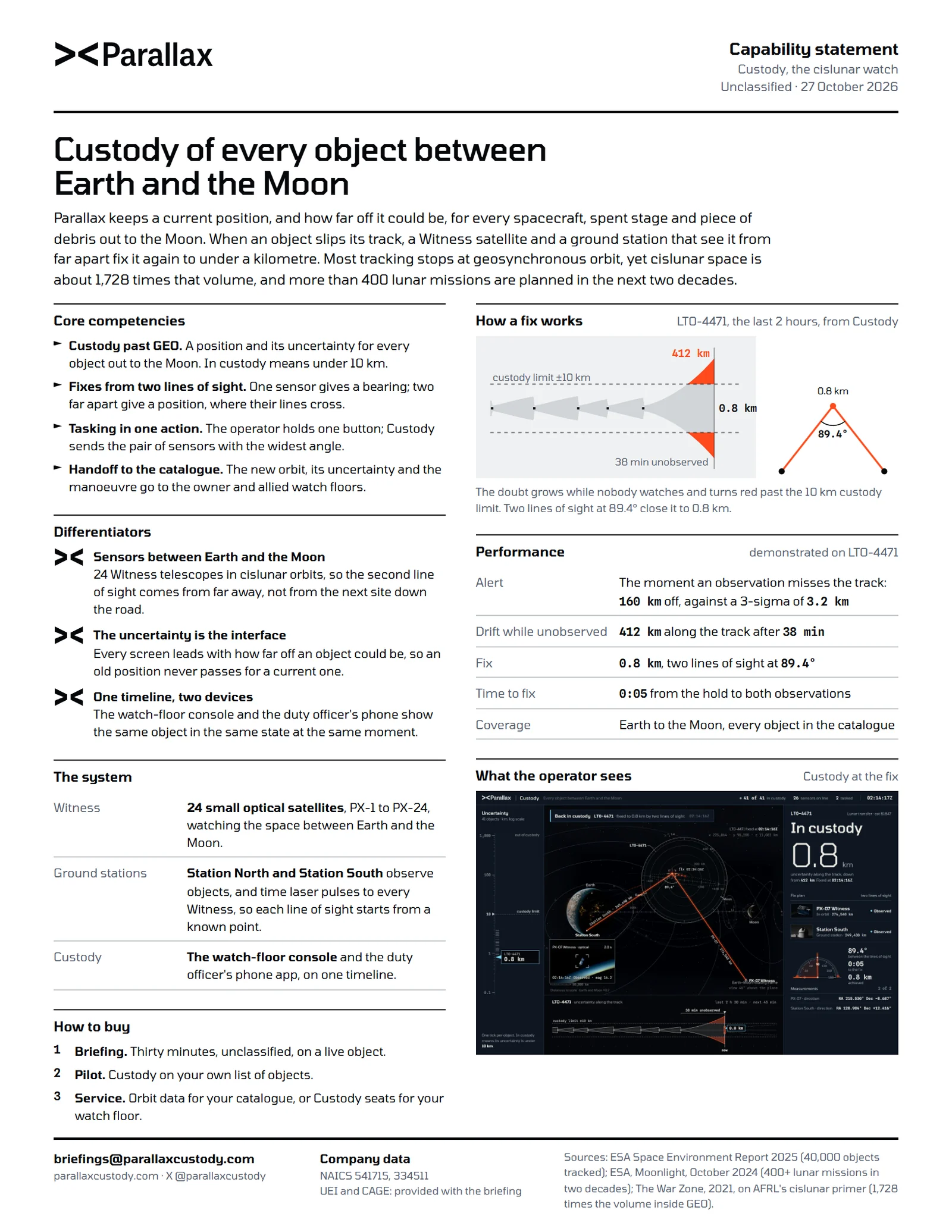
One page tells a contracting officer what Parallax does, how it works and how to buy it.
Technical notes
- Open the brief ↗
- The Space Force's commercial office buys through a marketplace: officials ask a question and companies answer with products (DefenseScoop, 2024).
- The page follows the order a contracting officer expects: what Parallax does, core competencies, differentiators, the system, how a fix works, performance, what the operator sees and how to buy.
Building something like Parallax? A 30-minute call: we look at your brand and product and tell you what we'd do first and what it costs.
Book a callOne job on two devices
The console and the phone show the same object in the same state.
The object
Watch floor
Duty officer
01 WatchAll in custody
02 AlertOut of custody
03 HoldOut of custody
04 TaskGetting a fix
05 FixIn custody
06 ReportHandoff sent
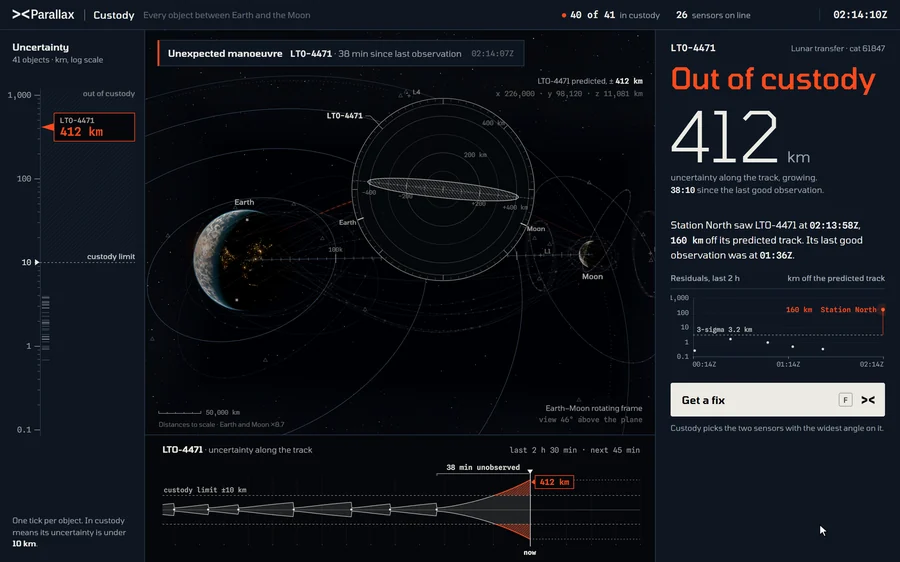
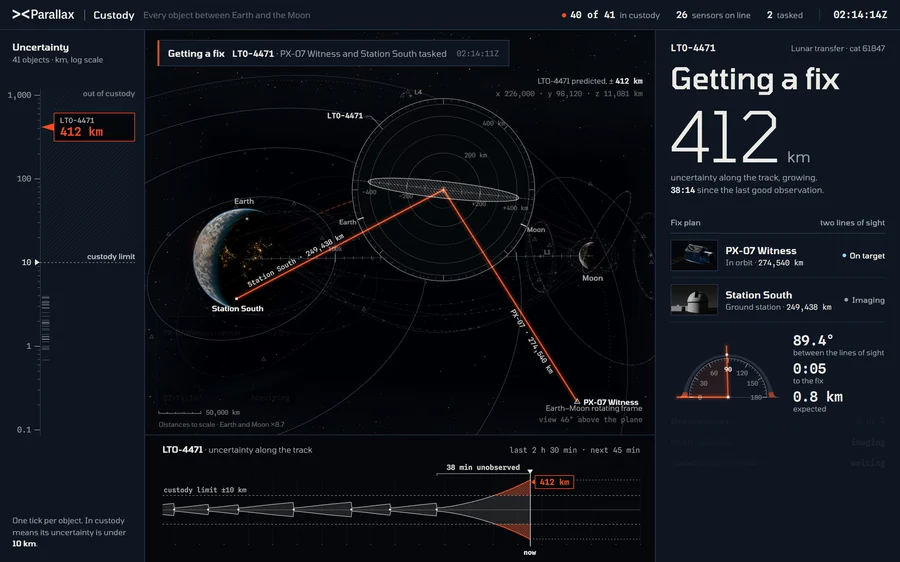
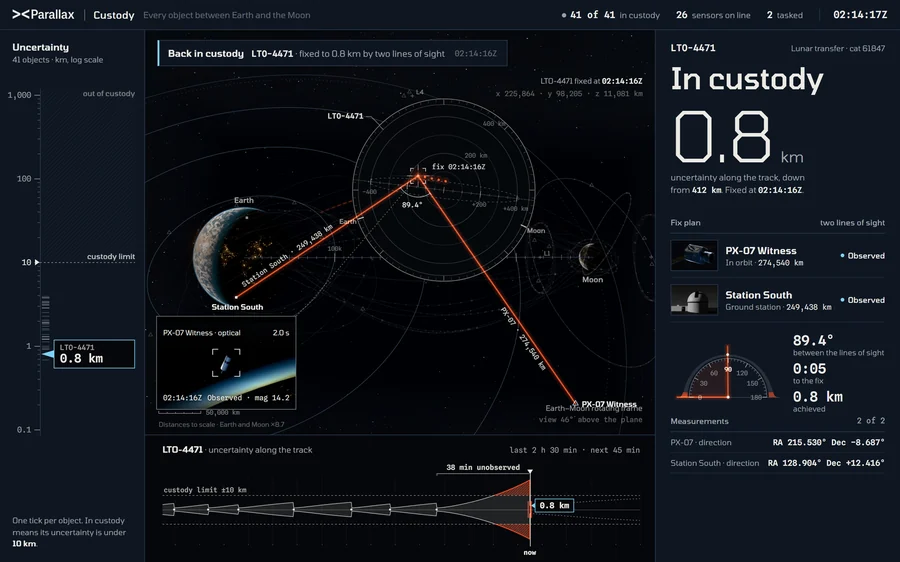
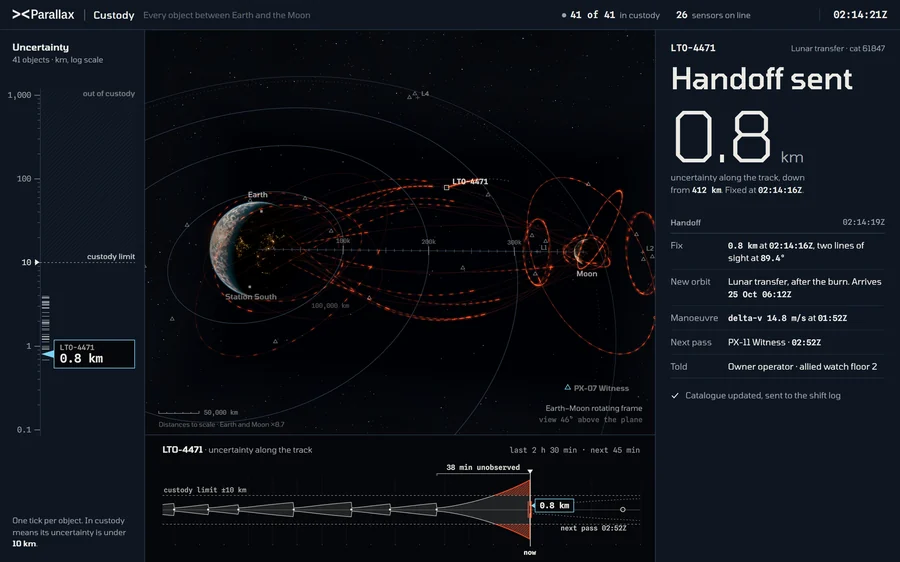
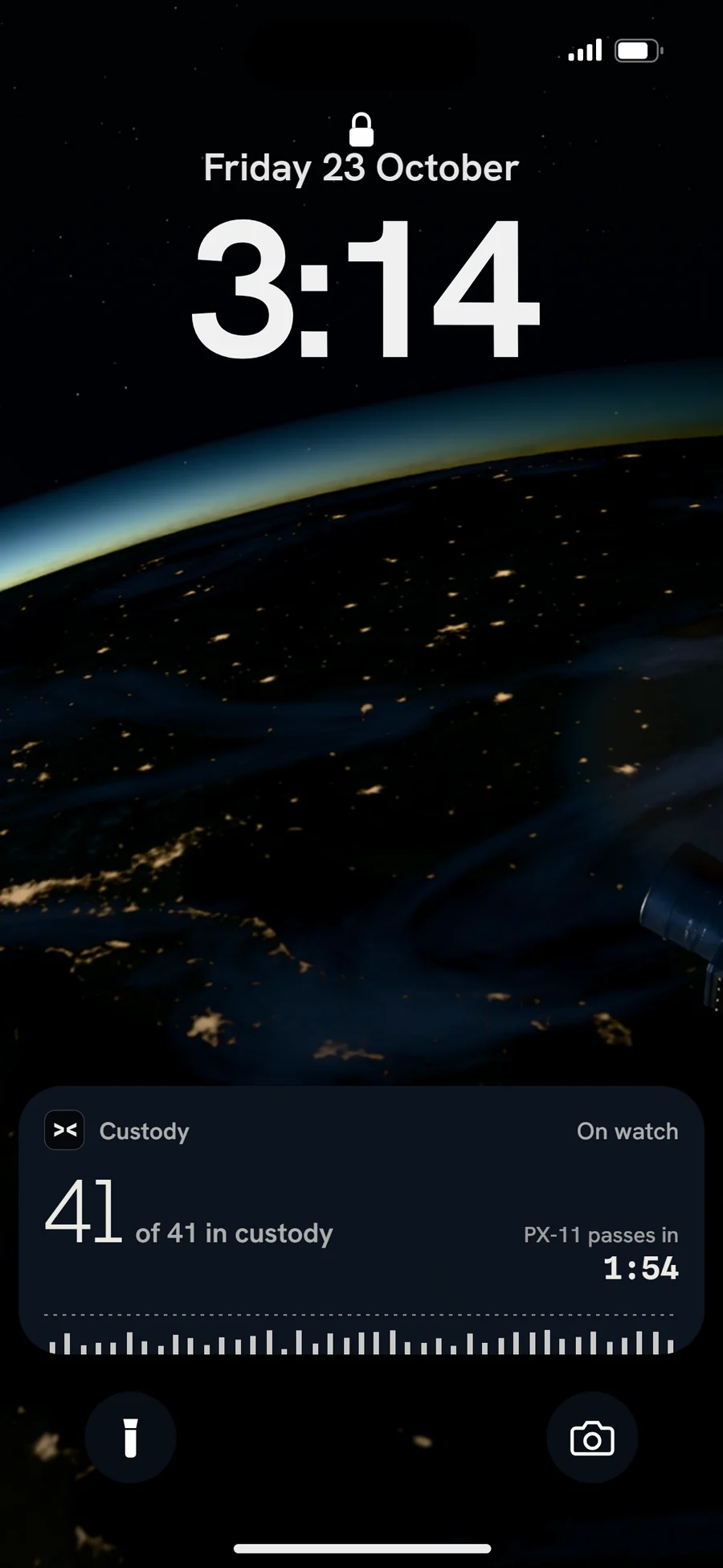
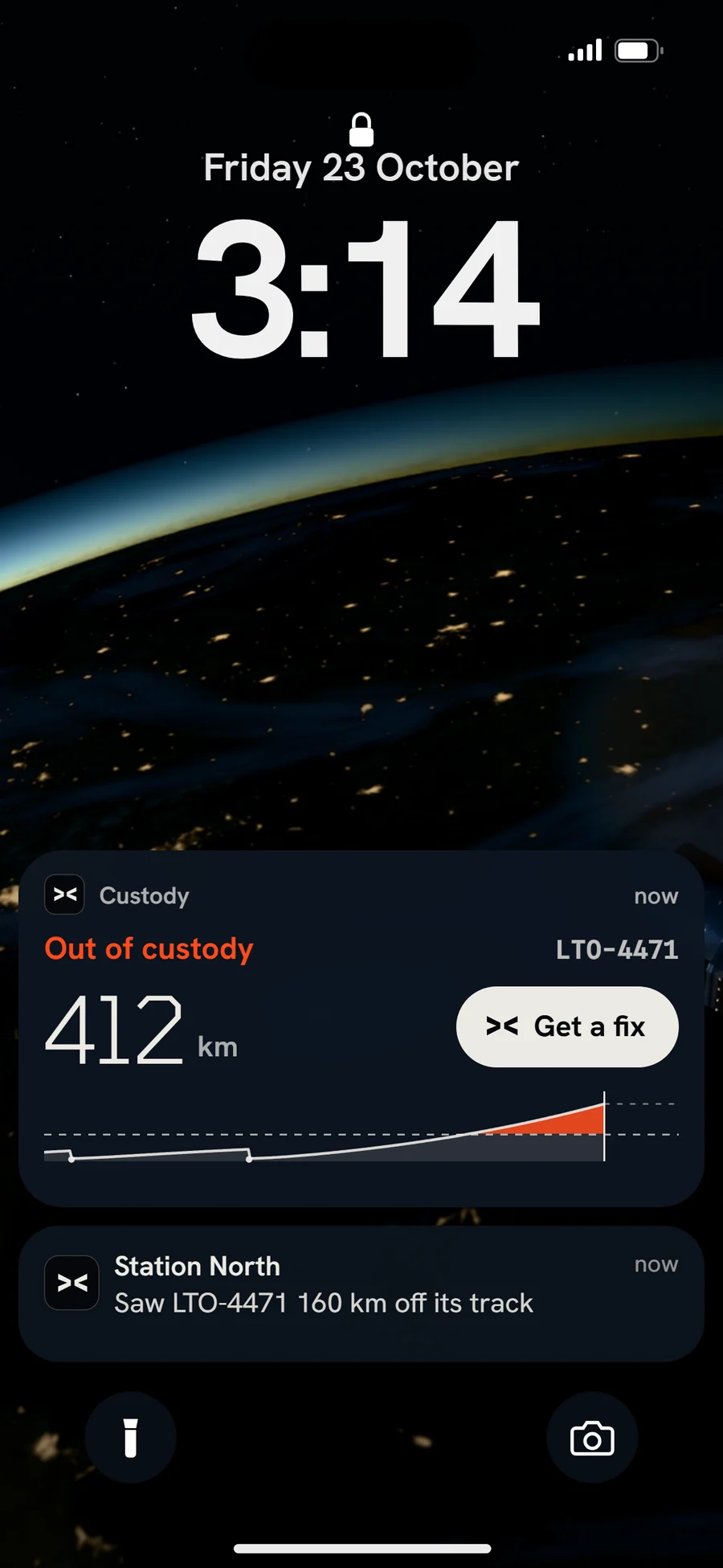
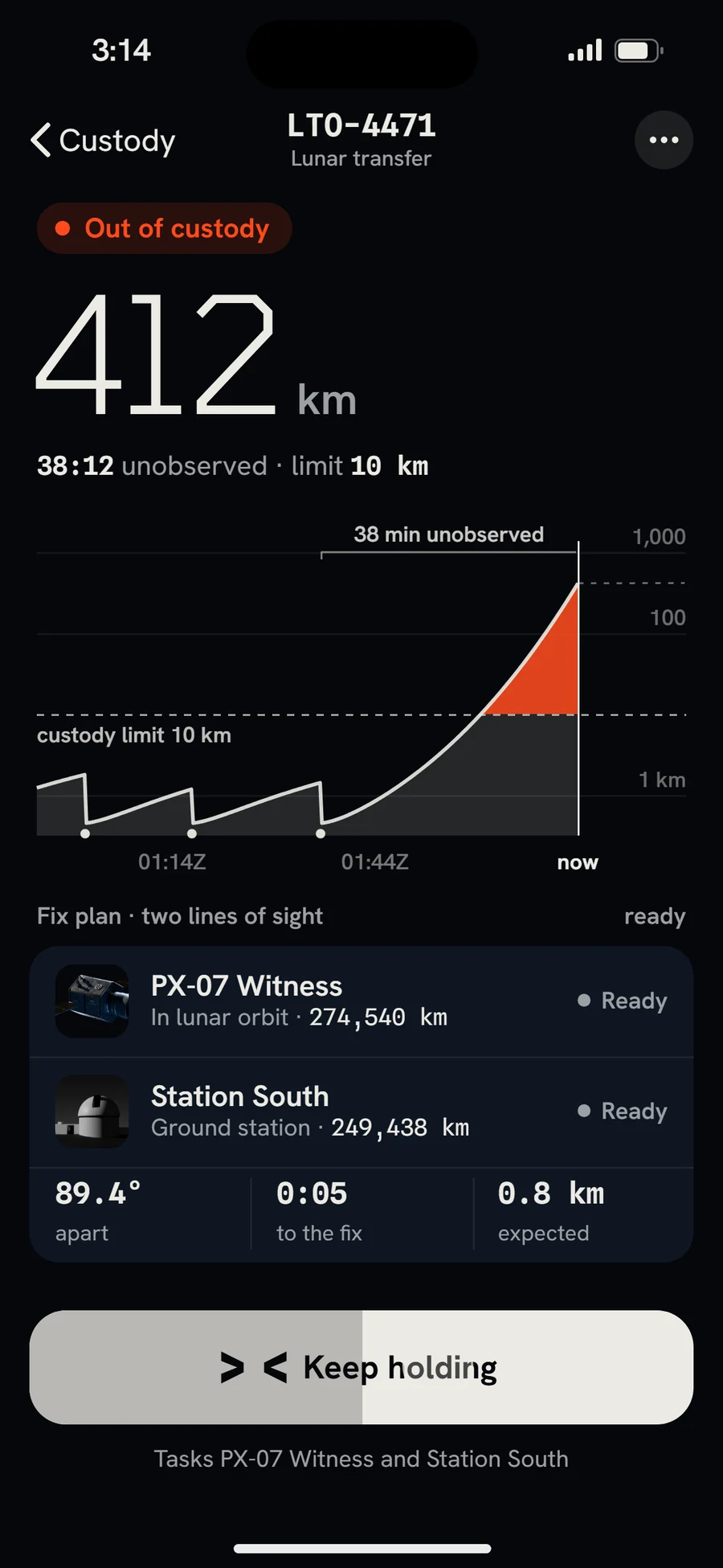
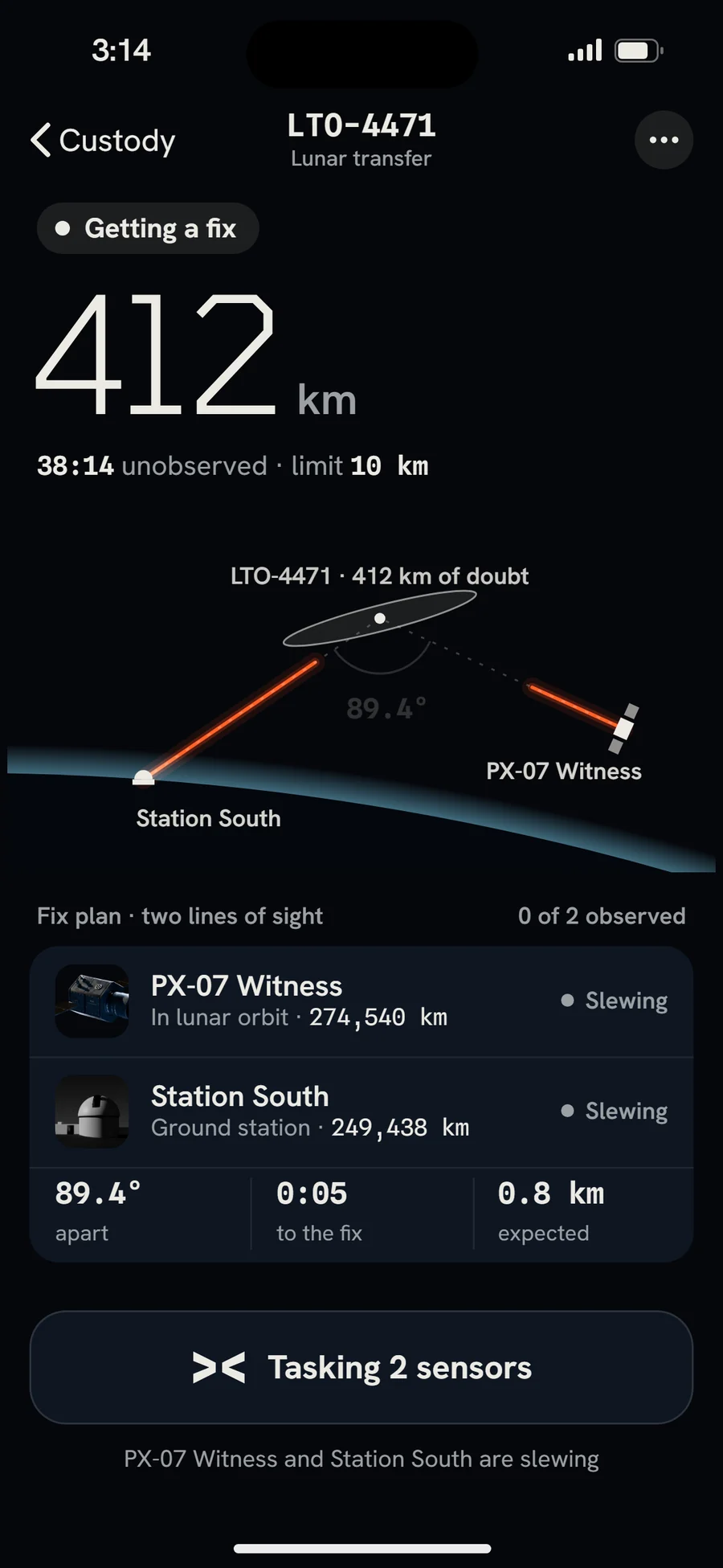
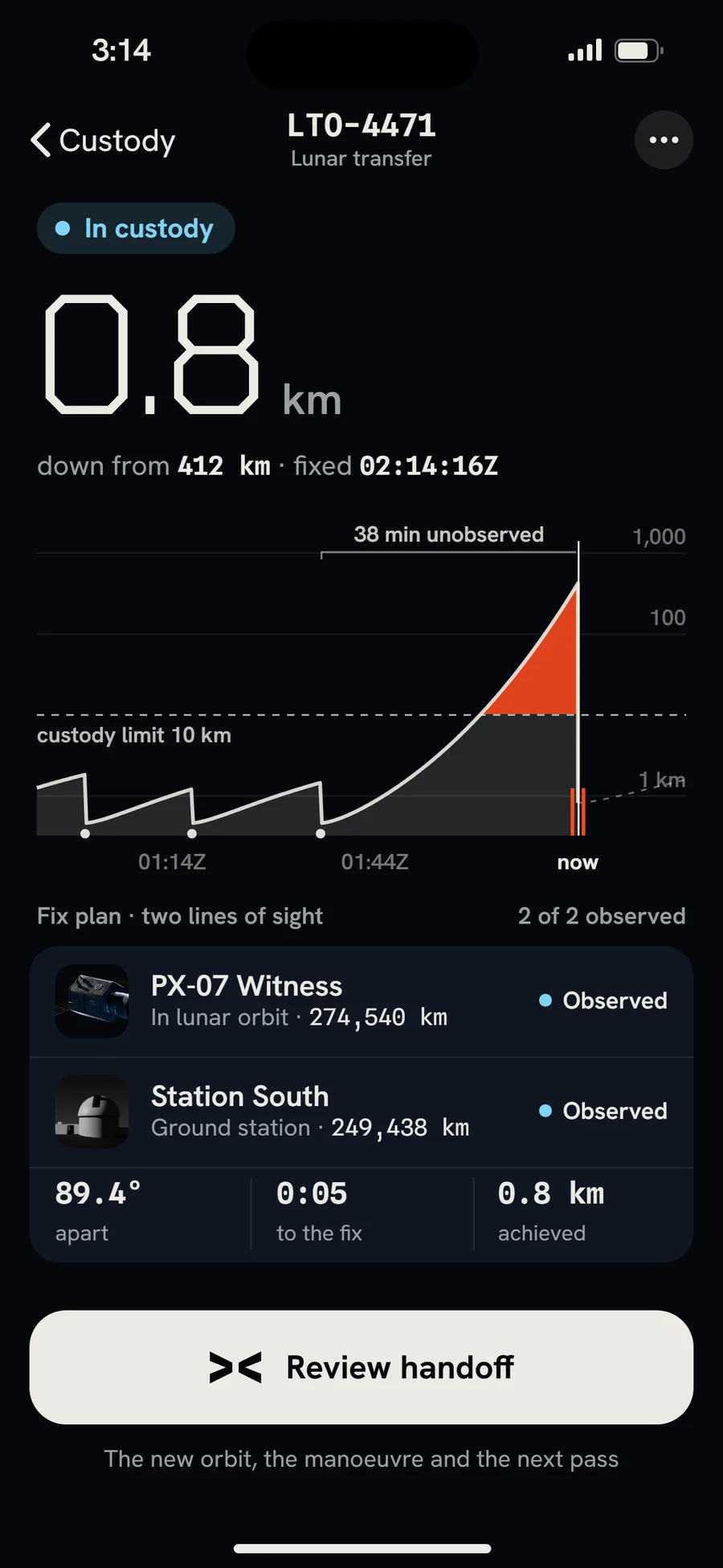
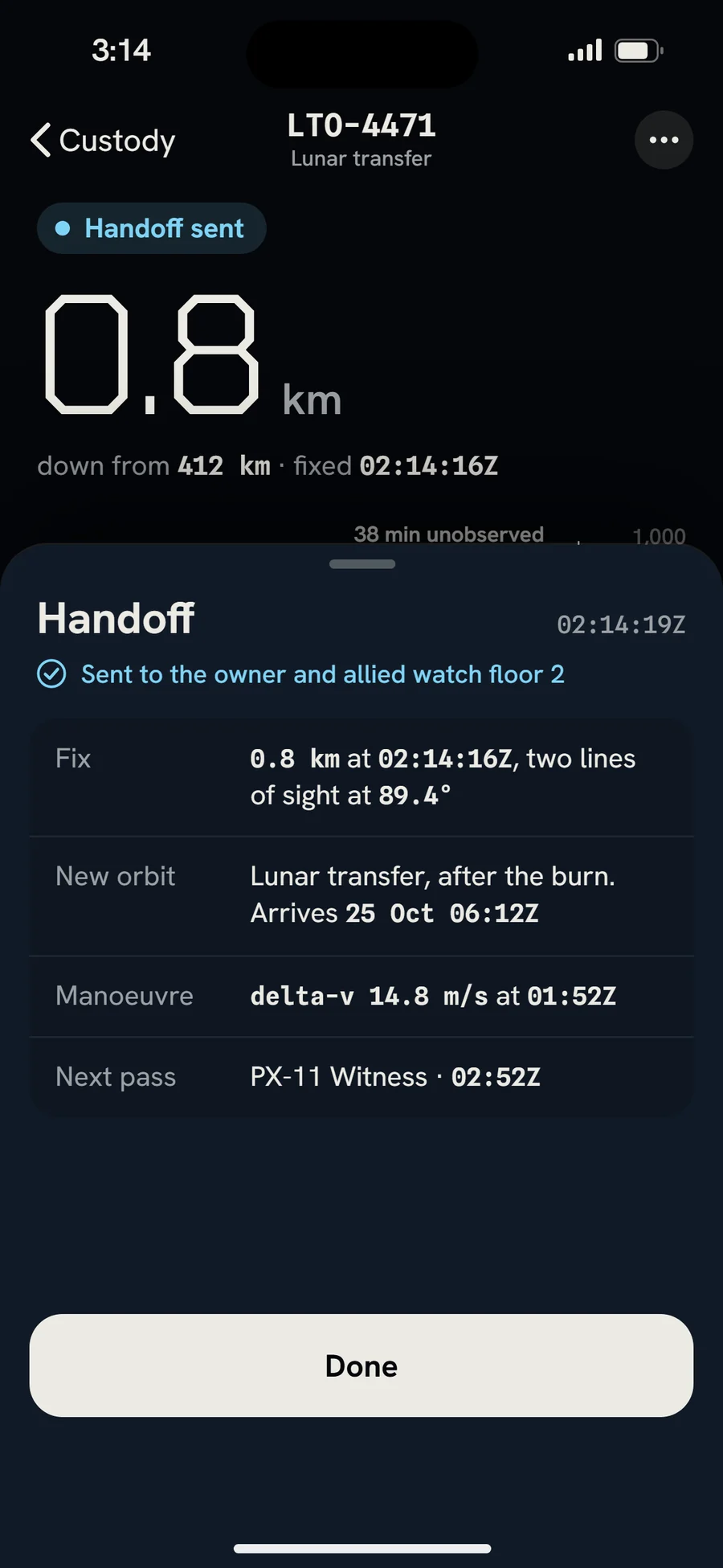
Grey: the map as we drew it first, every box a real part. Final: the same eleven screens as they shipped.
Technical notes
- Five jobs: know at once when an object misses its track; send a second sensor in one action; approve a fix from the phone; get the handoff written; trust a quiet watch.
- Five states, named on every screen: all in custody, out of custody, getting a fix, in custody, handoff sent.
The design system
One tokens file keeps the console, the phone app and the brief matching as the company grows.
Colour, by job
--groundSpace #05070BThe page, the map and the app--panelNavy #0E1622Docked panels, the sheet, the Live Activity--ruleSteel #2A3A4C1 px rules, range rings and axes--inkBone #ECEAE4Type, hairlines, marks and buttons--selectCyan #7FD3F5The Earth's edge, and what you picked or sent--signalFlare #FF4A1CLines of sight, tracks, the fix and the one alert
The type ladder, at 1440
--t-hero112 px0.8--t-state48 pxIn custody--t-title20 pxFix plan--t-body14 pxUncertainty along the track--t-label12 pxStation South · ground laser--t-data12.5 px02:14:16Z RA 215.530°--t-small11 pxEach tick is one object.
Space and corners
--s14 px--s28 px--s312 px--s416 px--s524 px--s632 px
2 px corners on chips and 3 px on cards. Panels are 392 px wide on the console, so the longest state word fits with room to spare.
Parts and their states
State word
- All in custody
- Out of custody
- Getting a fix
- In custody
- Handoff sent
Sensor
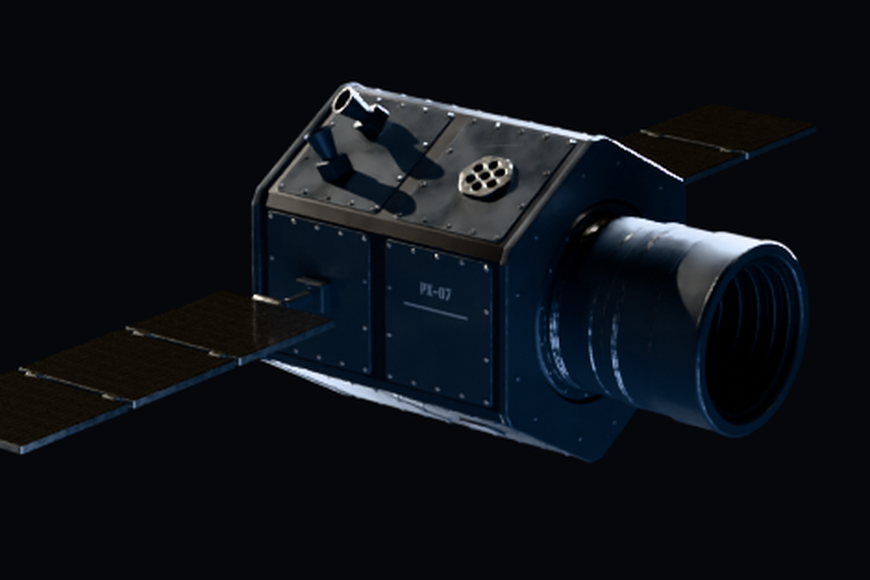 PX-07 WitnessSlewing
- PX-07 WitnessImaging
- PX-07 WitnessOn target
- PX-07 WitnessObserved
Hold button
- Hold to get a fix
- Keep holding
- Tasking 2 sensors
- Fixed · 0.8 km
Try it
Out of custody
Press and hold for a second, or hold Space or Enter.
Technical notes
- Red-orange only ever marks a line of sight. Cyan means selected. Every button is bone white.
- Colours are named by job: ground, panel, rule, ink, select, signal. Type: Tomorrow for words and the big number, Spline Sans Mono for data.
- Every text colour passes WCAG AA (W3C, 1.4.3): bone 16.8 to 1, grey 7.6, red-orange 6.0. Each state has a word, so colour never carries meaning alone (W3C, 1.4.1).
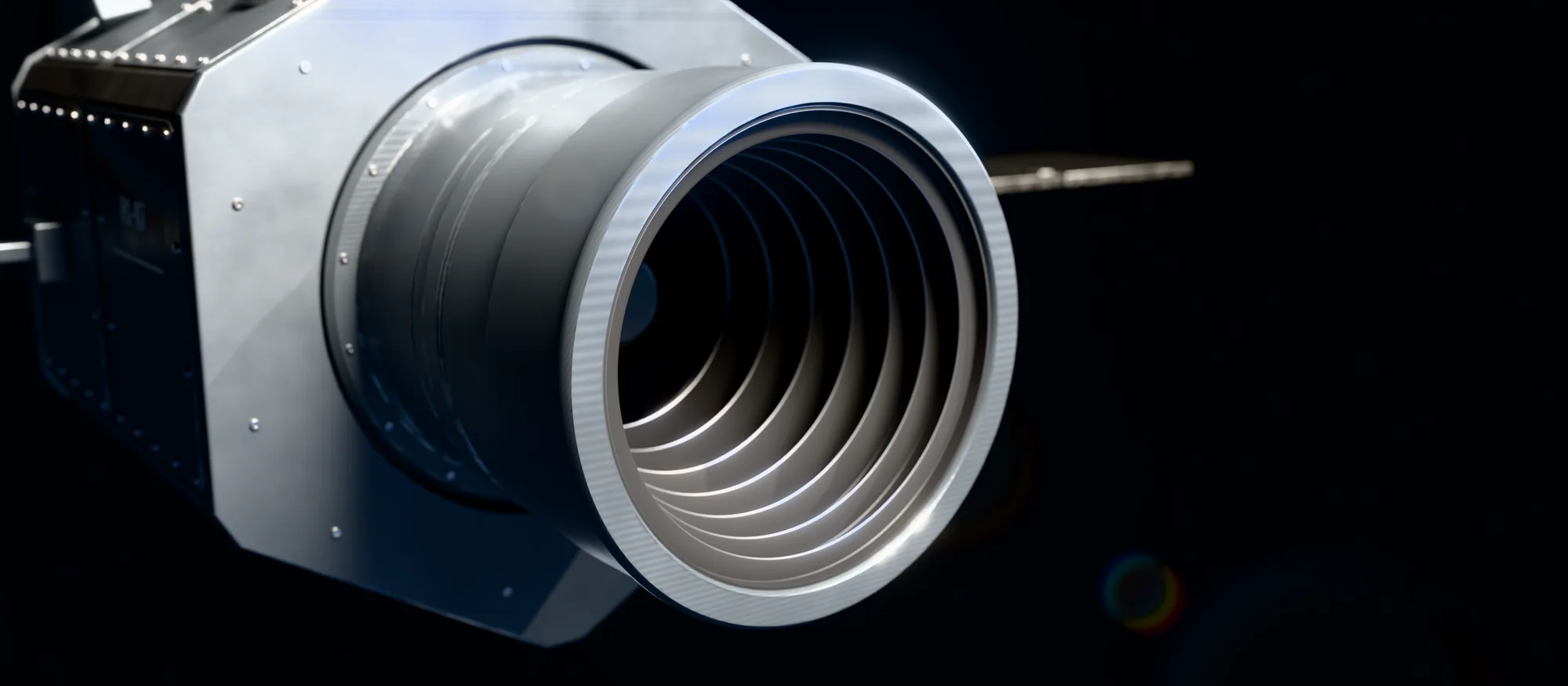
PX-1 Witness, the satellite
Investors can turn the satellite in their hands before it flies.
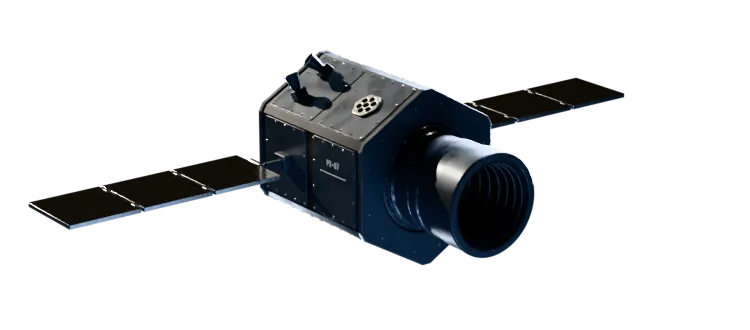
- TelescopeSeven rings inside the tube keep sunlight off the lens.
- Laser reflectorsSeven laser mirrors on the top face, for ranging from the ground.
- Star trackersTwo star cameras keep track of where the telescope points.
- PowerTwo solar wings of three panels each, turned toward the sun.
Technical notes
- Drag the satellite to turn it.
- The body is machined gunmetal, lit by the sun and by blue light off the Earth. Seven laser reflectors on top let the ground stations measure its distance.
- The Moon and the Earth are built from NASA imagery.
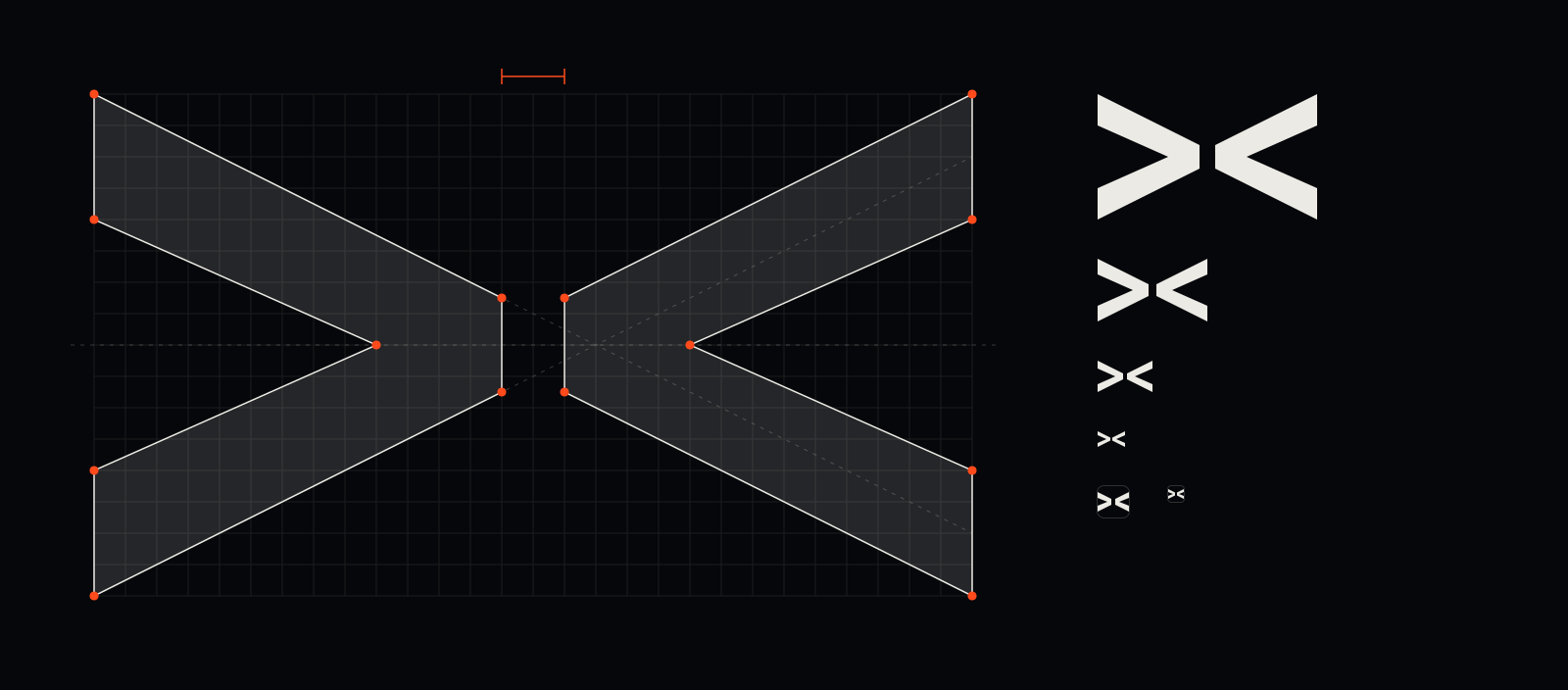
Two chevrons, one gap
A mark that looks established from a 16 px favicon to a trade-show poster.



Technical notes
- Two chevrons point at one gap: the spot where two lines of sight meet.
- The mark sits on an 8-unit grid, 224 by 128 units, with straight cuts on whole-number points. The outer edges run at 1:2 and the gap is 16 units.
- The wordmark is Mona Sans, spaced by hand. Mark and word read at 16 px.
- The joins are one grid unit lighter, the corners overshoot the cap line by 2 units, and the small mark keeps a 2 px gap at 16 px. The two l's of the word are cut at the chevrons' 1:2 slope.
Three posters
Posters that show the work, for hiring cleared engineers and for trade-show stands.
Technical notes
- The 40,000 tracked objects are from the ESA Space Environment Report, 2025; most are in low orbit. The distances to the geostationary ring (35,786 km) and the Moon (384,400 km) are standard values. The fix poster uses Custody's own error model, σ / (√2 · sin(θ/2)) with σ 0.8 km: ±0.8 km at 90 degrees and ±8.1 km at 8.
The identity board
Seven pieces of the brand in one 10-second loop for LinkedIn and X.
What we'd ship
For a funded defense or space company.
- Win the operator
- The watch-floor console and its phone app, on one tokens file
- Look established
- A mark that holds from 16 to 512 px, with type and colour rules
- Get through procurement
- A one-page capability brief in the product's own design
Want this for your company?
Book 30 minutes. We'll tell you what we'd change first in your brand and on your first screen, and what it would cost.
Book a call, get a price range
The thinking behind it.
All insights- Launches13 min read
The Web3 product and brand checklist: what to fix before your raise or token launch
What to fix in your product and brand before a raise, TGE or mainnet: 40 checks for wallet flows, failure states, contract addresses, token pages, whitepaper, deck and launch assets.
- Product9 min read
Wallet onboarding UX best practices: from the first screen to a failed transaction
How to design wallet onboarding for non-crypto users: show the product before the wallet, give people without one a way forward, explain every signature, and design the network, gas and failure states.
- Product8 min read
How much does Web3 product and brand design cost?
What Web3 design costs in 2026: Clutch data on branding, UX and web design projects, why dApp UI, token launch sites and crypto brands cost more than the screen count suggests, a worked seed-stage example and how to compare quotes.