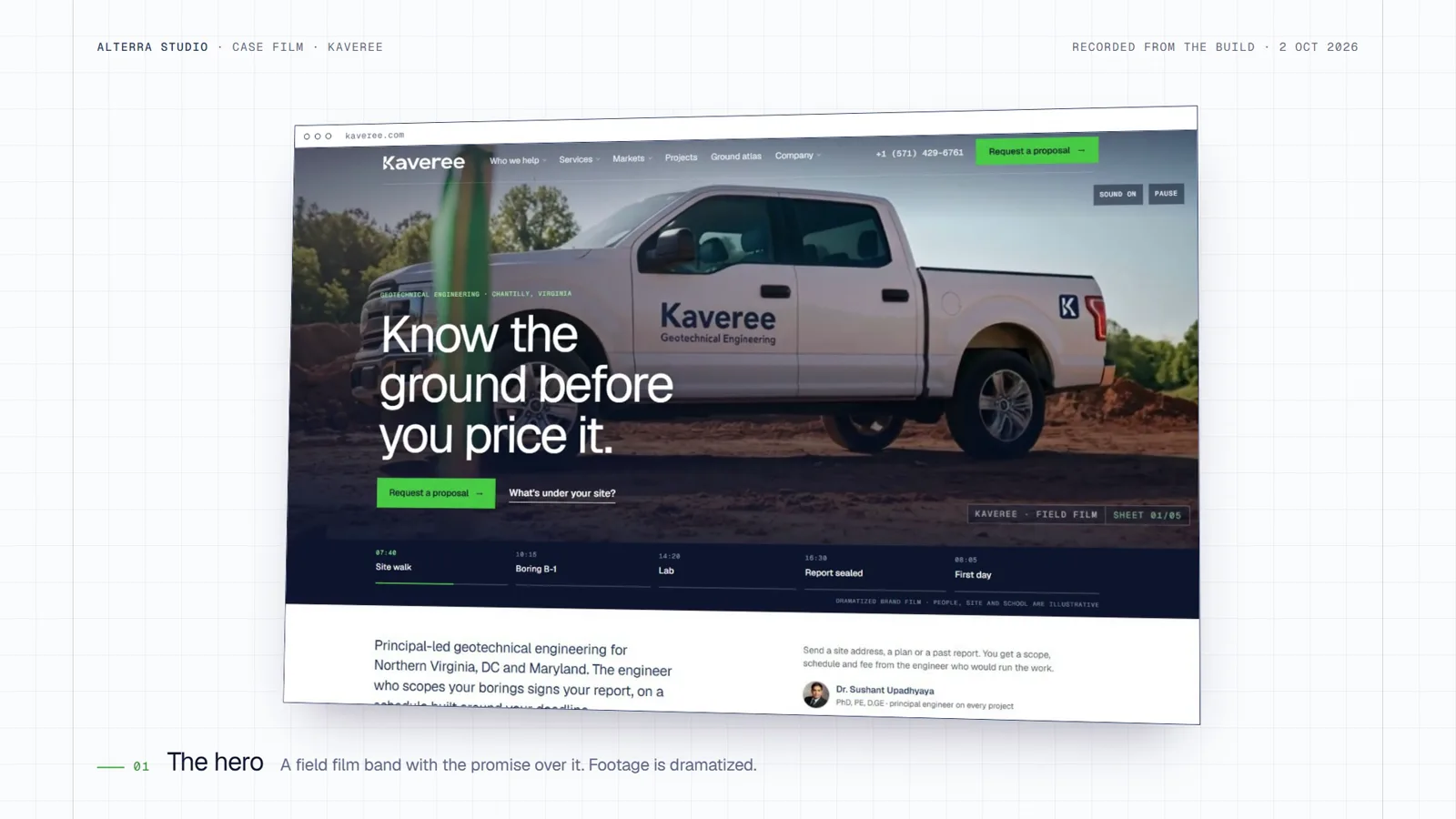
Client case study · Website for a geotechnical firm
Kaveree needed a website that turns a referral into a call.
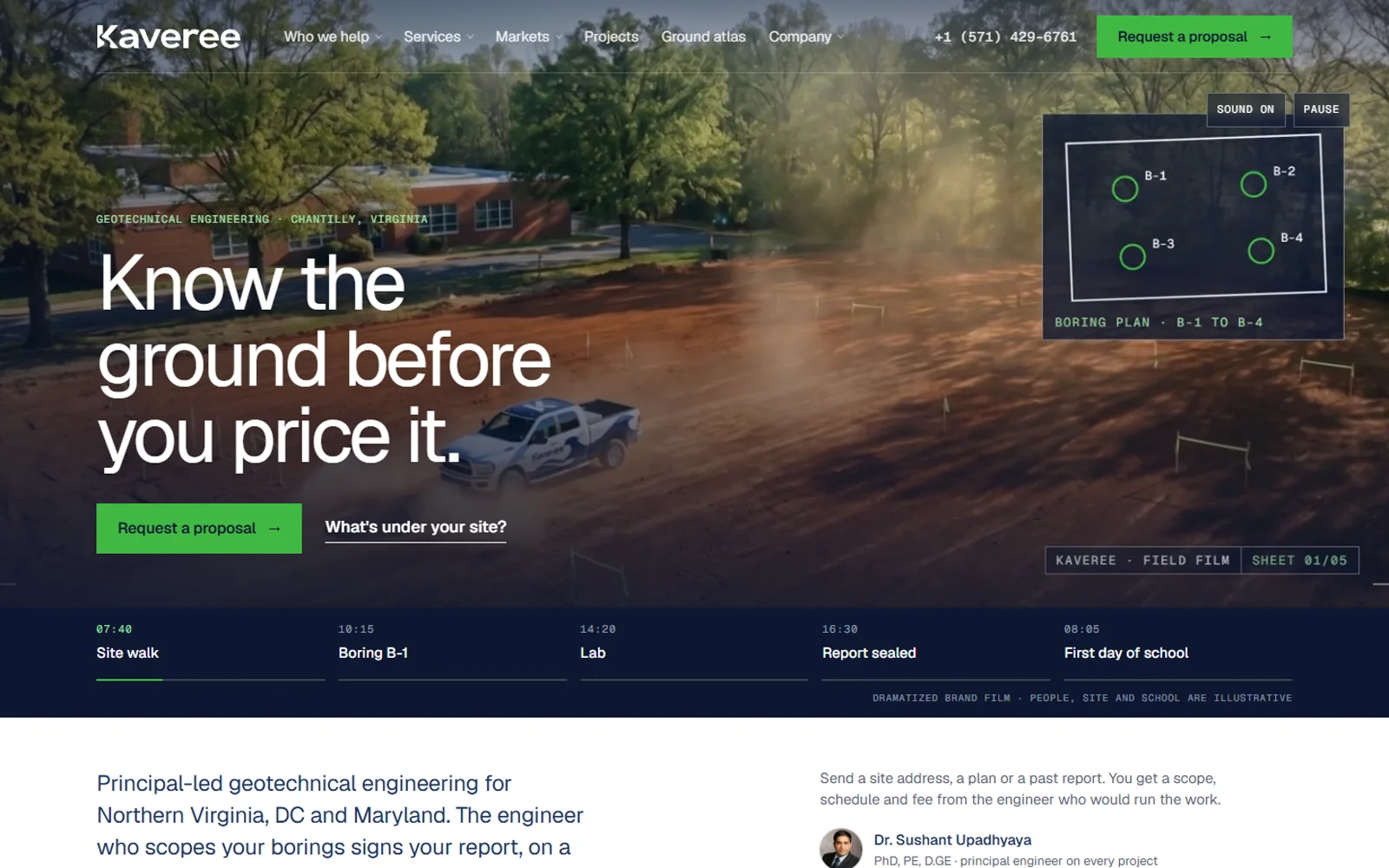
Kaveree is a principal-led geotechnical engineering firm in Chantilly, Virginia. It competes with national firms for design-build, public and private work. We rebuilt its site around what its buyers fear, showed the engineer they would work with, and tested the result against 15 competing home pages.
- Client
- Kaveree, Inc., geotechnical engineering, Chantilly, Virginia
- Our part
- Brand (from June 2026), then the website's strategy, design, build, 3D and films
- Status
- Reviewed and approved by Kaveree; the site goes live on kaveree.com after launch
- Tools
- Astro, Blender, HyperFrames, Jev
The problem and the brief
Most of Kaveree's work starts with a referral. When the referred buyer looks the firm up, the website decides whether that turns into a call.
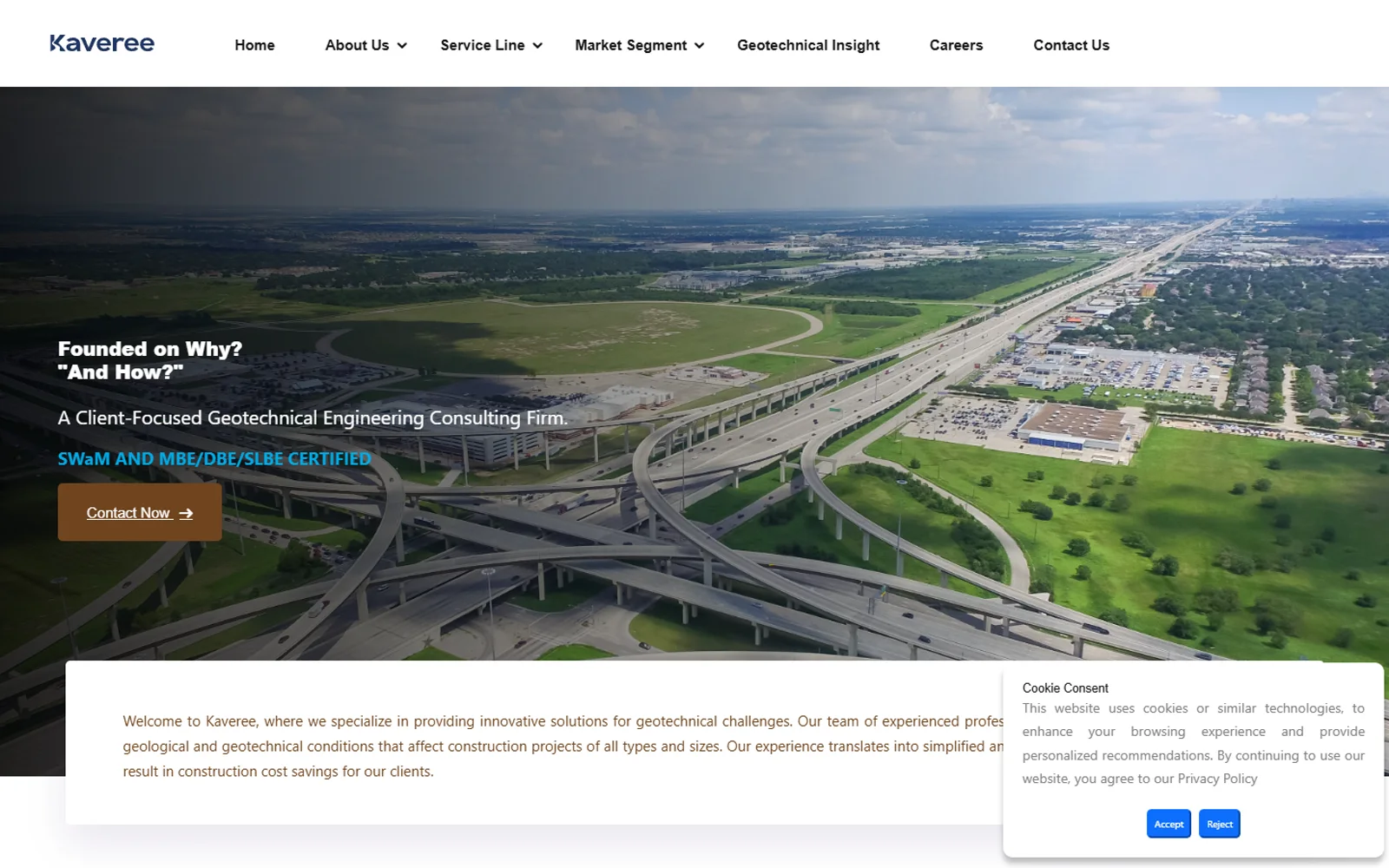
Kaveree is a small firm. It competes with national and regional engineering companies for design-build, public-sector and private work. We had already rebuilt its brand: the logo, identity, merchandise and a statement of qualifications. Its first website draft was a Framer template that still carried the template's sample testimonials, team and contact details.
The brief was to confirm a referral fast and remove the reasons not to call. Kaveree's leaders asked for a site as calm and technical as the sites of large engineering firms, with no hype.
The research
of AEC buyers ask a colleague first
then check the firm's website. References are the check they use least.
Source: Hinge Marketing, How Buyers Buy: AEC. The same study found sellers overestimate price; buyers pick on reputation, senior people and fit.
What buyers write
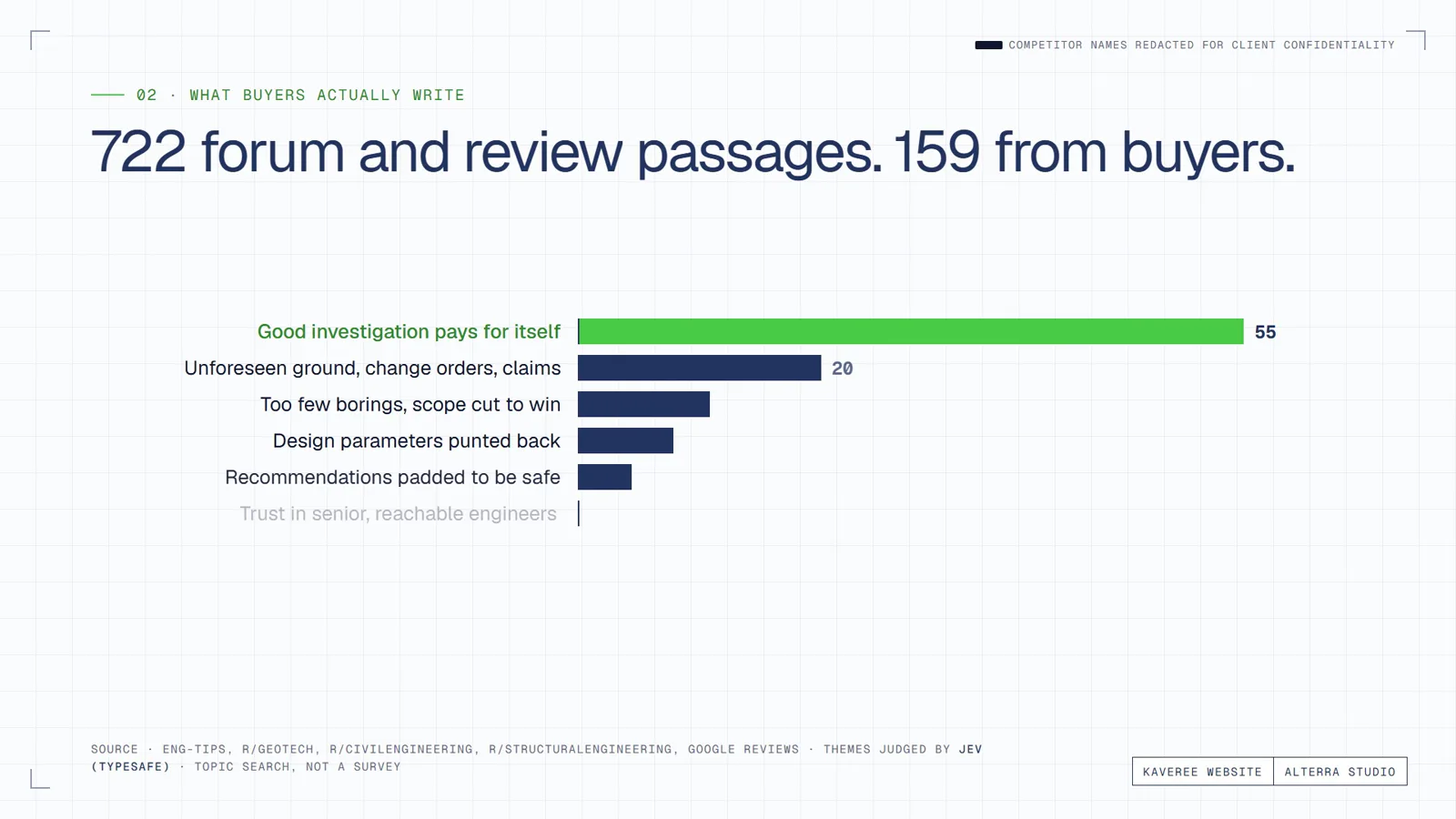
We gathered forum threads and review pages where engineers, owners and contractors talk about hiring a geotechnical firm: Eng-Tips, Reddit's engineering communities and Google reviews. Jev read 722 passages and judged each one. Was it about hiring a geotechnical consultant or about ground risk? Which theme did it express, and who was speaking?
- 722passages read
- 299about hiring or ground risk
- 159from the buying side
- Good investigation pays for itself; skimping costs more later55
- Unforeseen ground, change orders, claims and redesign20
- Too few borings, or scope cut to win on price11
- Reports that hand the design parameters back9
- Recommendations padded to be conservative9
- Independence and pressure on testing7
- Trust in senior engineers you can reach7
- Two reports, two answers on the same ground6
The threads were found by searching for these topics, so the counts show what comes up most often. They are not a survey. Classified by Jev; 30 passages fitted no theme.
Four buyers, four fears
- Design-build team
We priced the ground blind.
- Developer or owner
Surprises after closing, and a report that says piles to be safe.
- Structural engineer
The report hands the design parameters back to us.
- Public agency
A firm that goes quiet after award.
The strategy: one section per fear
The home page makes one argument. Ground problems cost least when they are found first; they get found late because exploration is cut, padded or handed down; a senior engineer who knows the local ground fixes that. Each fear gets the section that answers it, with something the visitor can try.
- Fear 1 · Design-build team
We priced the ground blind.
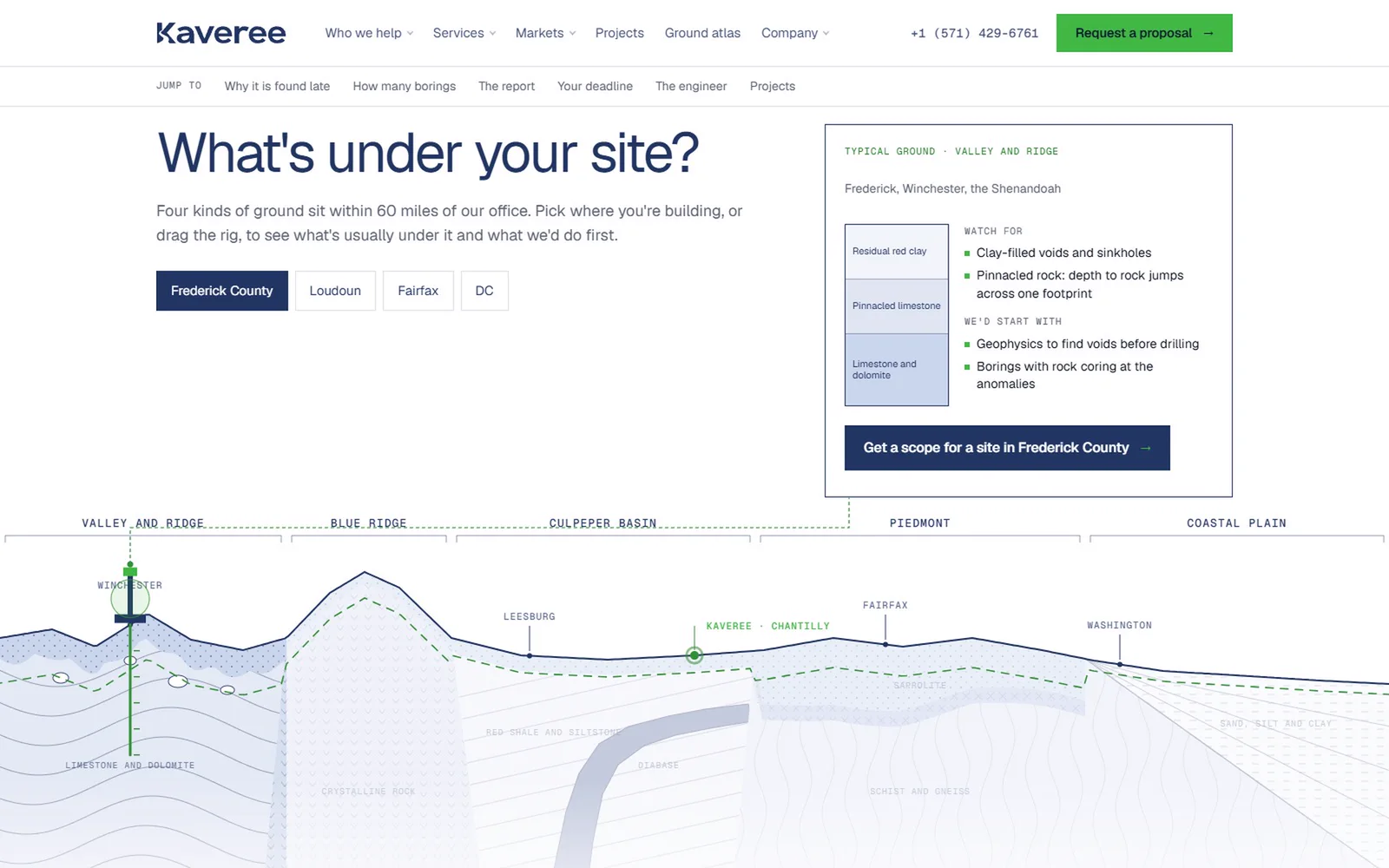
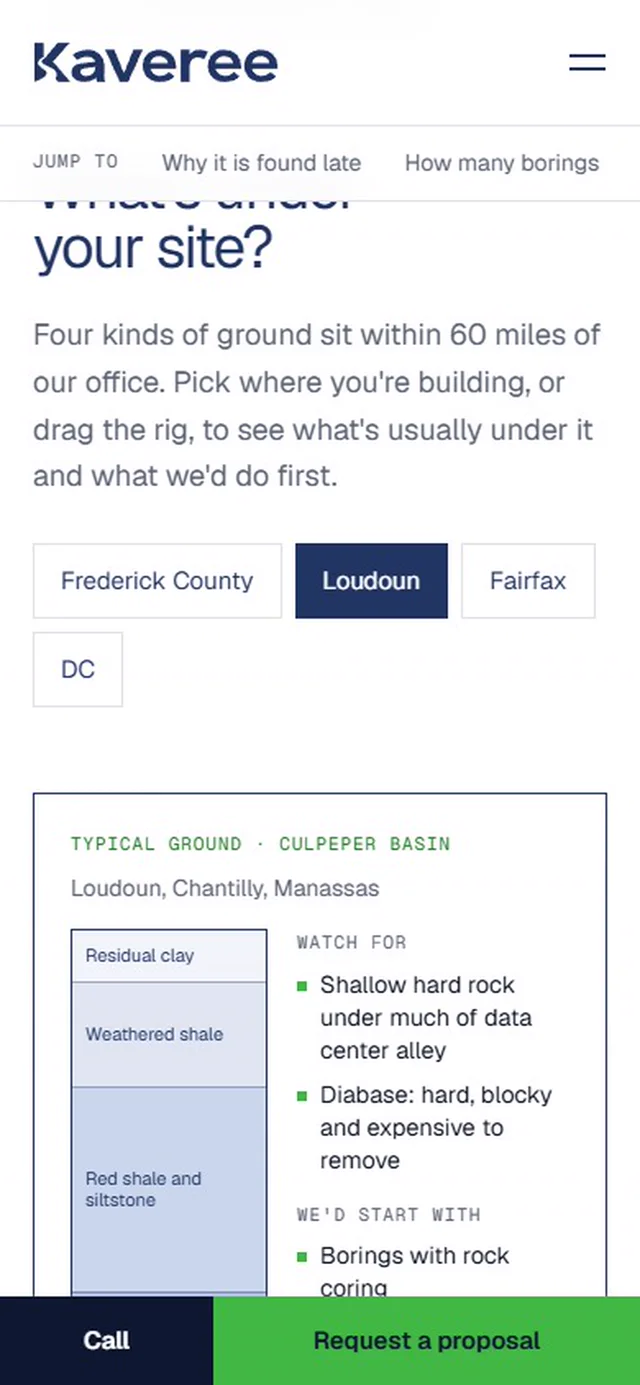
What's under your site?
Pick a county and the site shows the typical ground there, what to watch for and the first exploration step Kaveree would take. The pick follows the visitor down the page and fills in the contact form.
Agencies and primes score a firm on knowledge of the local ground. Four geologic provinces sit within 60 miles of Kaveree's office.
- Fear 2 · Developer or owner
Surprises after closing, and a report that says piles to be safe.
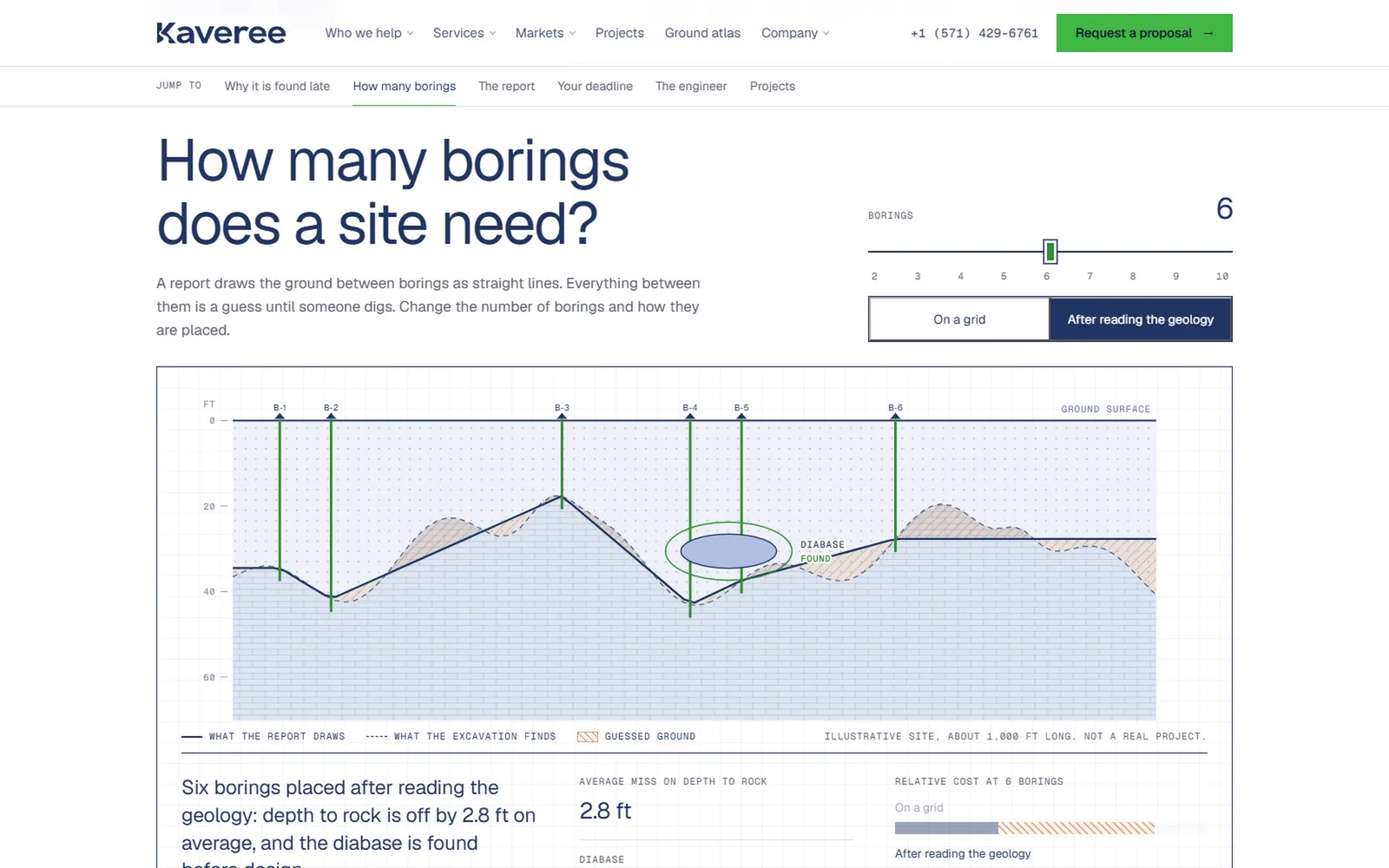
How many borings does a site need?
The visitor sets the number of borings and places them on a grid or by the geology. The drawing shades the ground a report would be guessing at and splits the cost of exploring from the cost of finding the problem later.
It is the theme buyers write about most: 55 of 159 buying-side passages say good investigation pays for itself.
- Fear 3 · Structural engineer
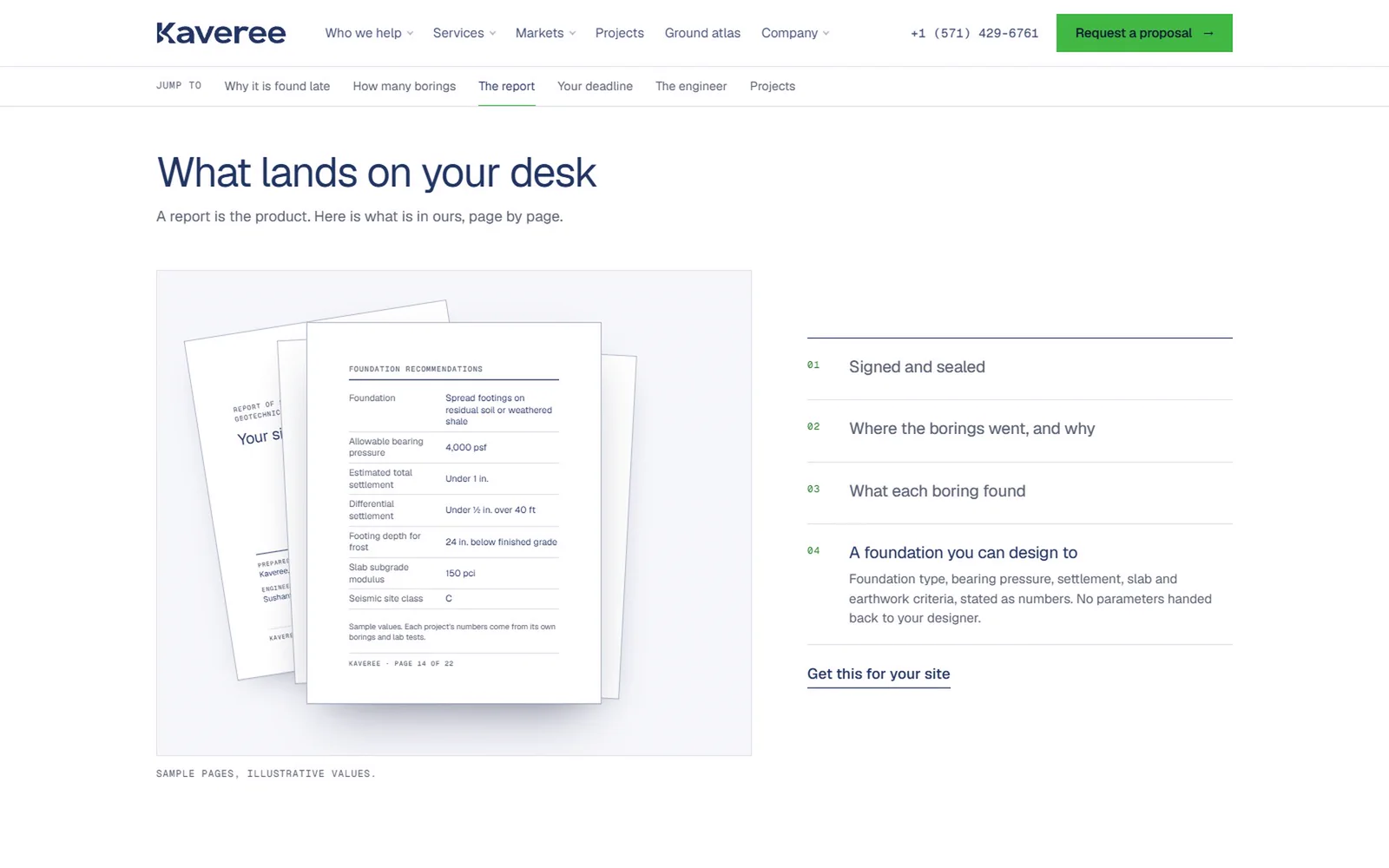
The report hands the design parameters back to us.
What lands on your desk
Four sample report pages: the sealed cover, the boring plan, a boring log and the foundation recommendations, with the values an engineer designs to.
Reports that punt the parameters back came up in 9 of the 159 passages. Showing the deliverable answers it before anyone asks.
- Fear 4 · Public agency
A firm that goes quiet after award.
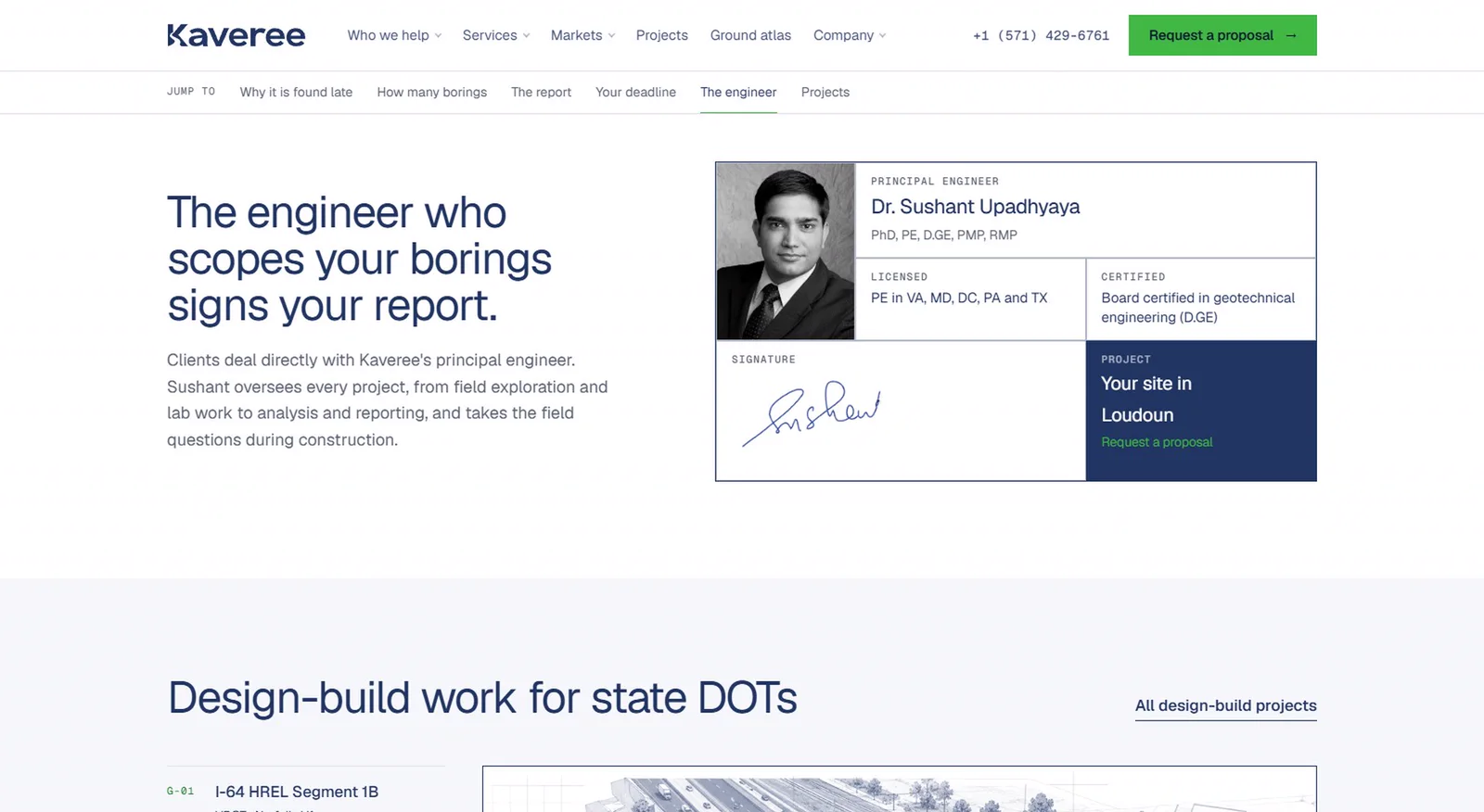
The engineer who scopes your borings signs your report
Dr. Sushant Upadhyaya's title block with his licences and his signature, drawn on screen. The engineer who scopes the borings signs the report and takes the field calls.
Agencies choose on qualifications and fear staff swaps after award. Most competitor home pages never name an engineer.
- And the clock
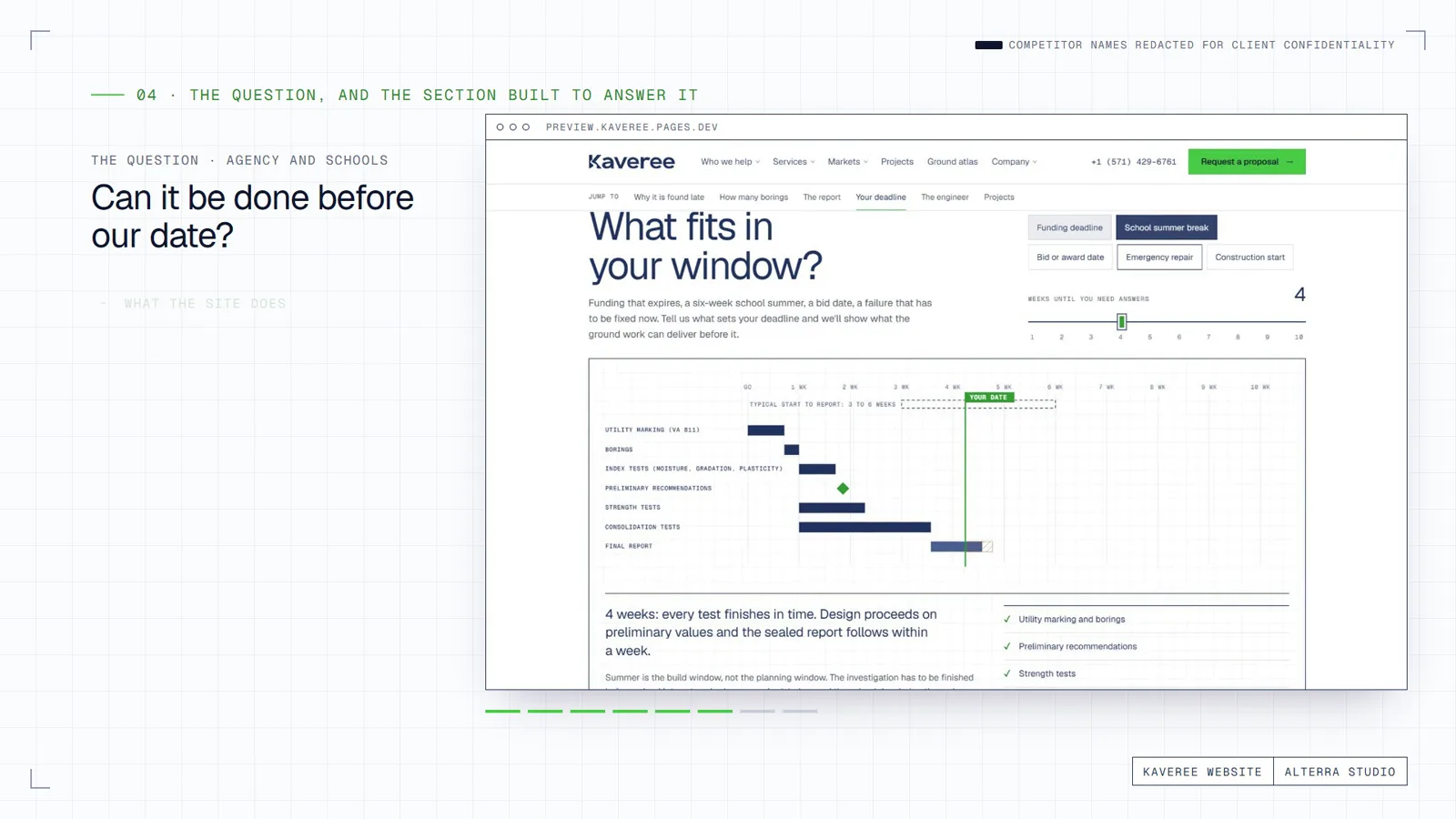
The funding has a date on it.
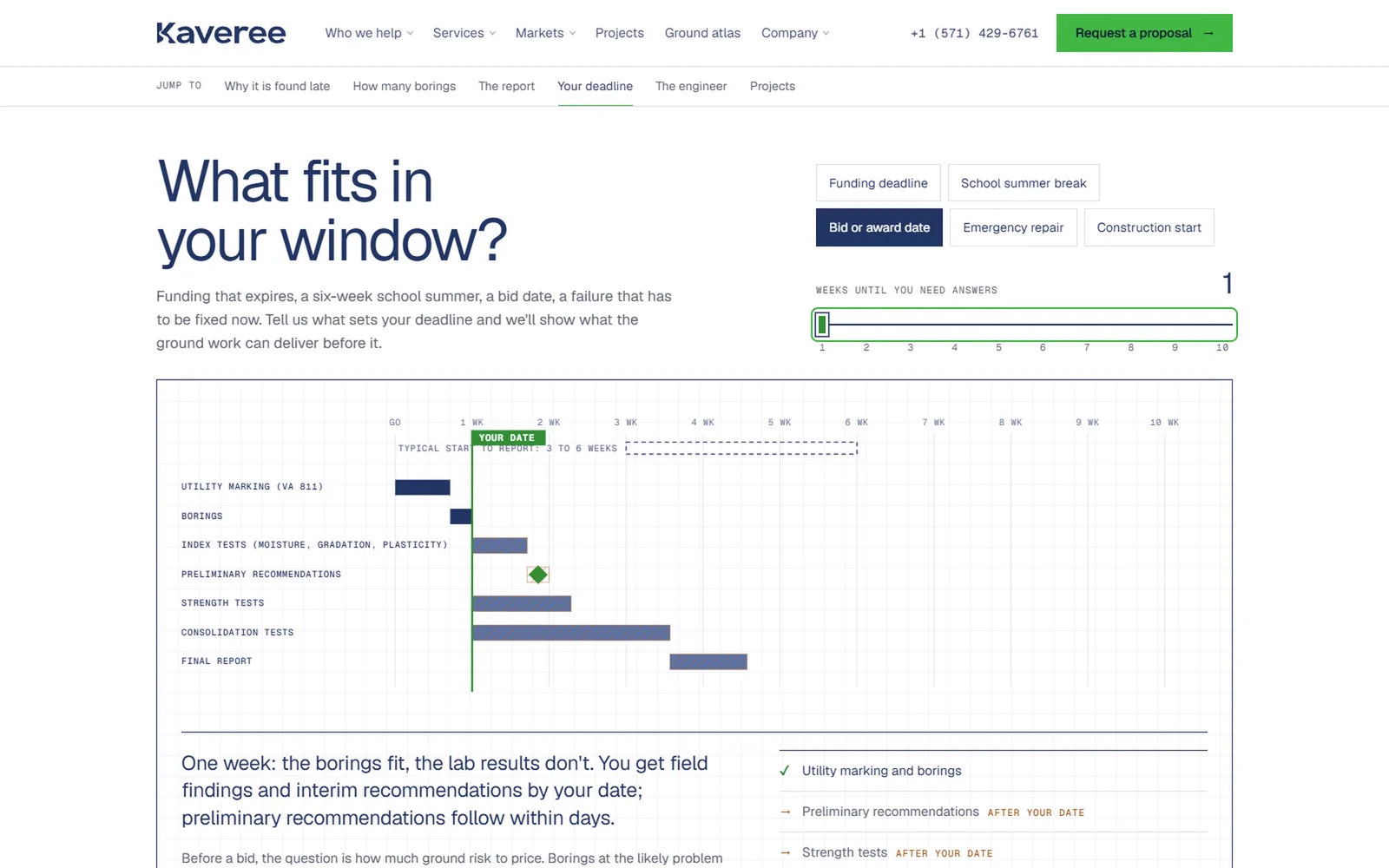
What fits in your window?
Kaveree's team told us clients work against fixed dates: funding windows, school summers, bid deadlines and emergencies. The visitor picks what sets the deadline and the weeks they have, and the schedule shows what finishes before the date and what follows it.
A typical investigation takes three to six weeks from notice to proceed, so the deadline is often the first question.
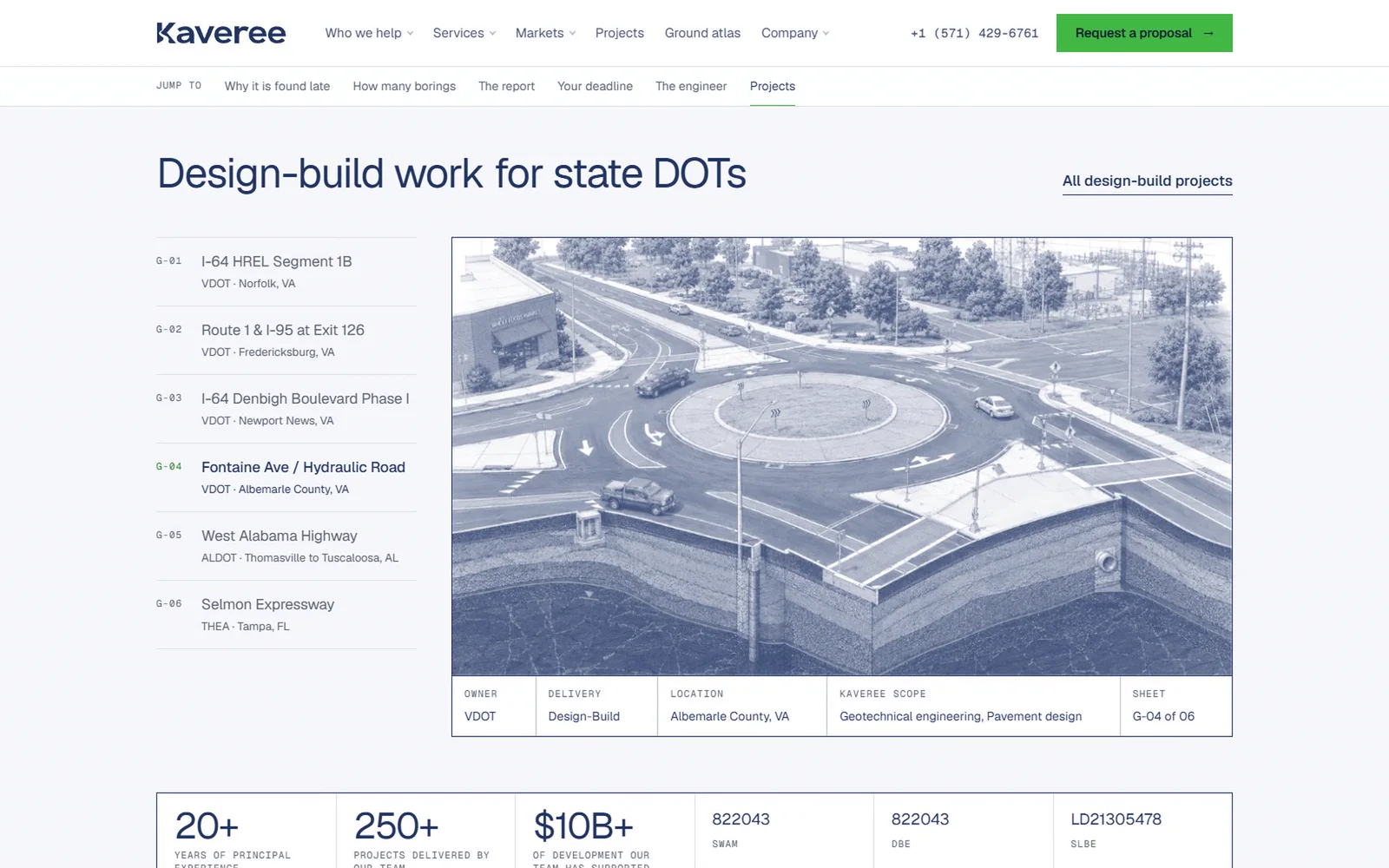
The proof sits below these sections: six DOT design-build projects drawn as sheets, each with the owner, delivery method, location and Kaveree's exact scope, then the firm's certification numbers in one title block.
The design system
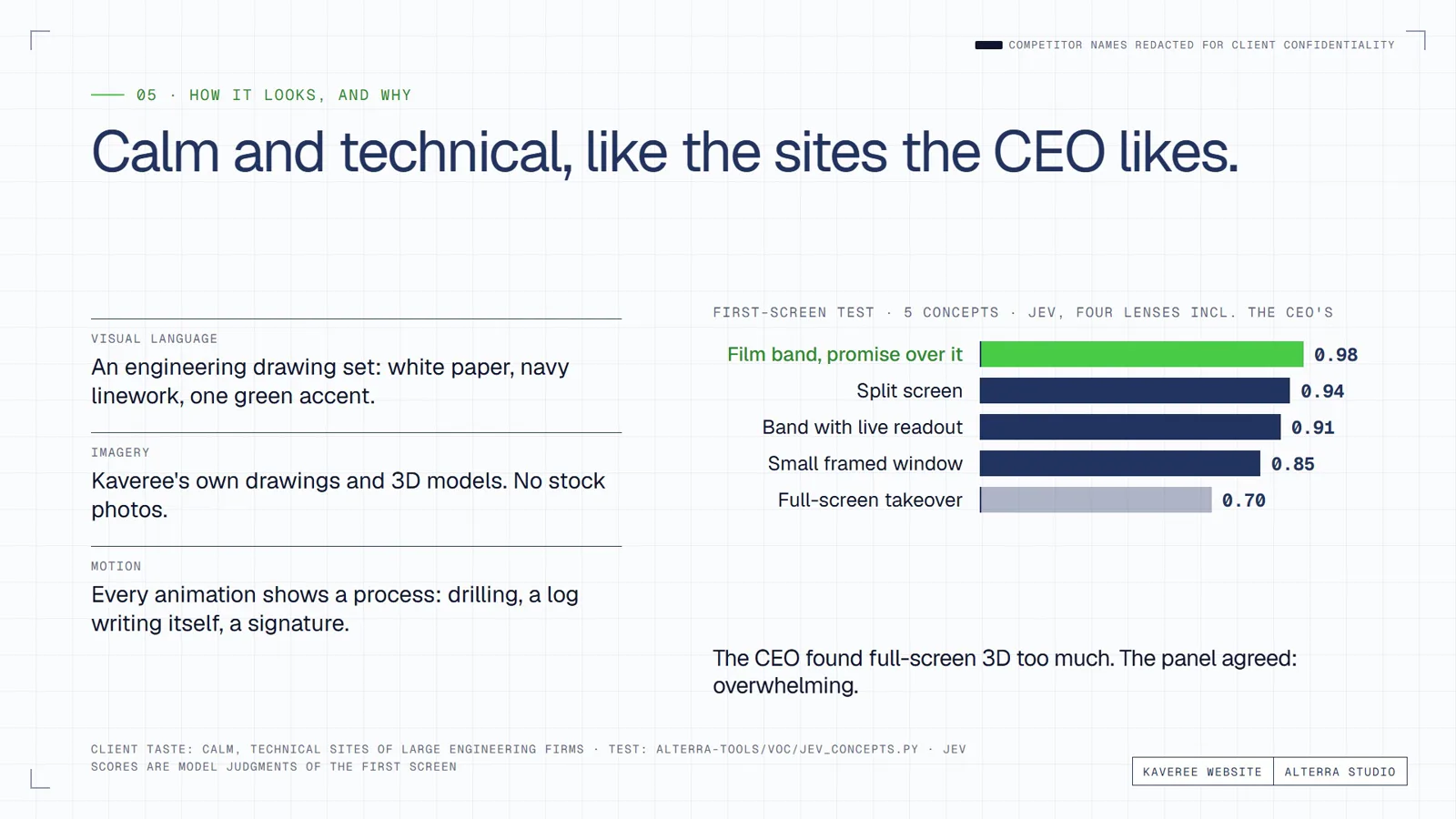
The site is drawn like an engineering drawing set, the format Kaveree's buyers read every day. Every image is Kaveree's own drawing or 3D model.
- Navy #203562Type and linework
- Green #40B843The one thing that matters in a drawing: groundwater, the boring, the active choice. Never a large fill.
- White paperThe primary colour, at the client's request
Type. Geist at regular weight for headlines, Geist Mono for drawing labels only.
Motion. Each animation shows a process: a boring drilled to rock, a log writing itself, a signature. All of it stops for visitors who ask for reduced motion.
Choosing the hero with Jev
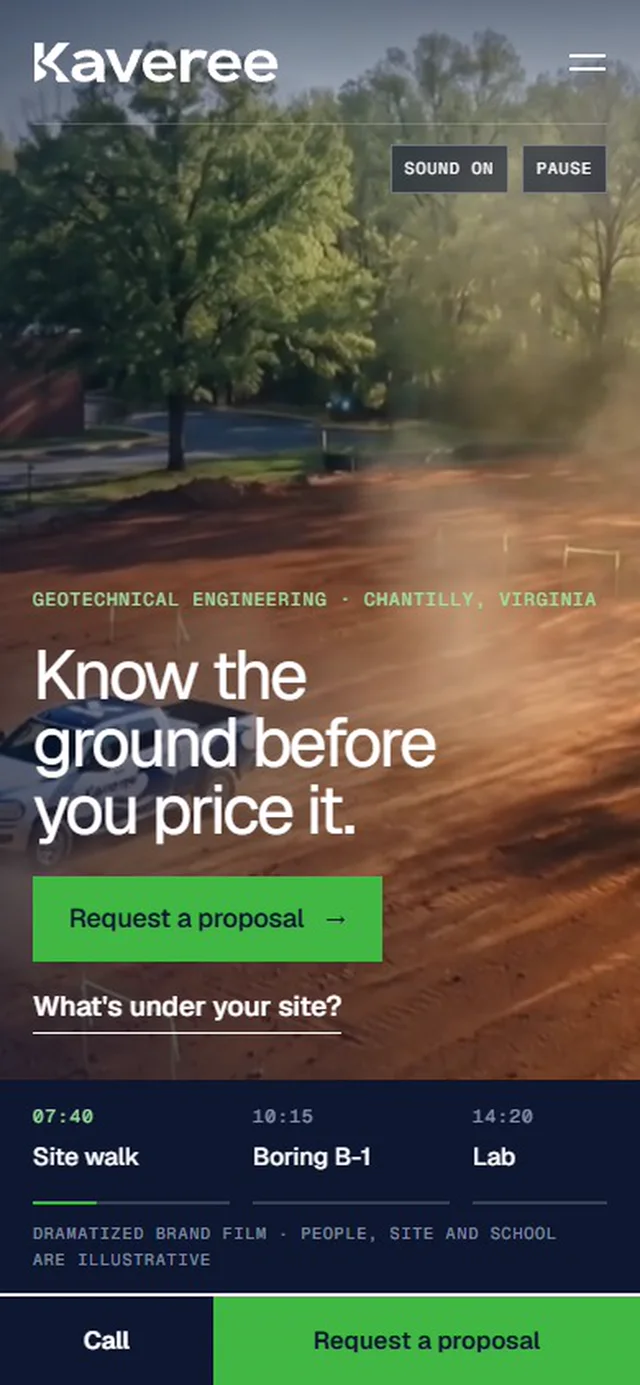
We tested first-screen concepts with Jev through four lenses, including Kaveree's CEO and two buyer types. A wide film band with the headline over its lower corner scored highest. A full-screen takeover scored lowest.
- Film band, headline over the film98 in 100
- Full-screen takeover70 in 100
The benchmark
We scored the new home page against 14 competitors and the old site, with the same questions and the same extraction for every page.
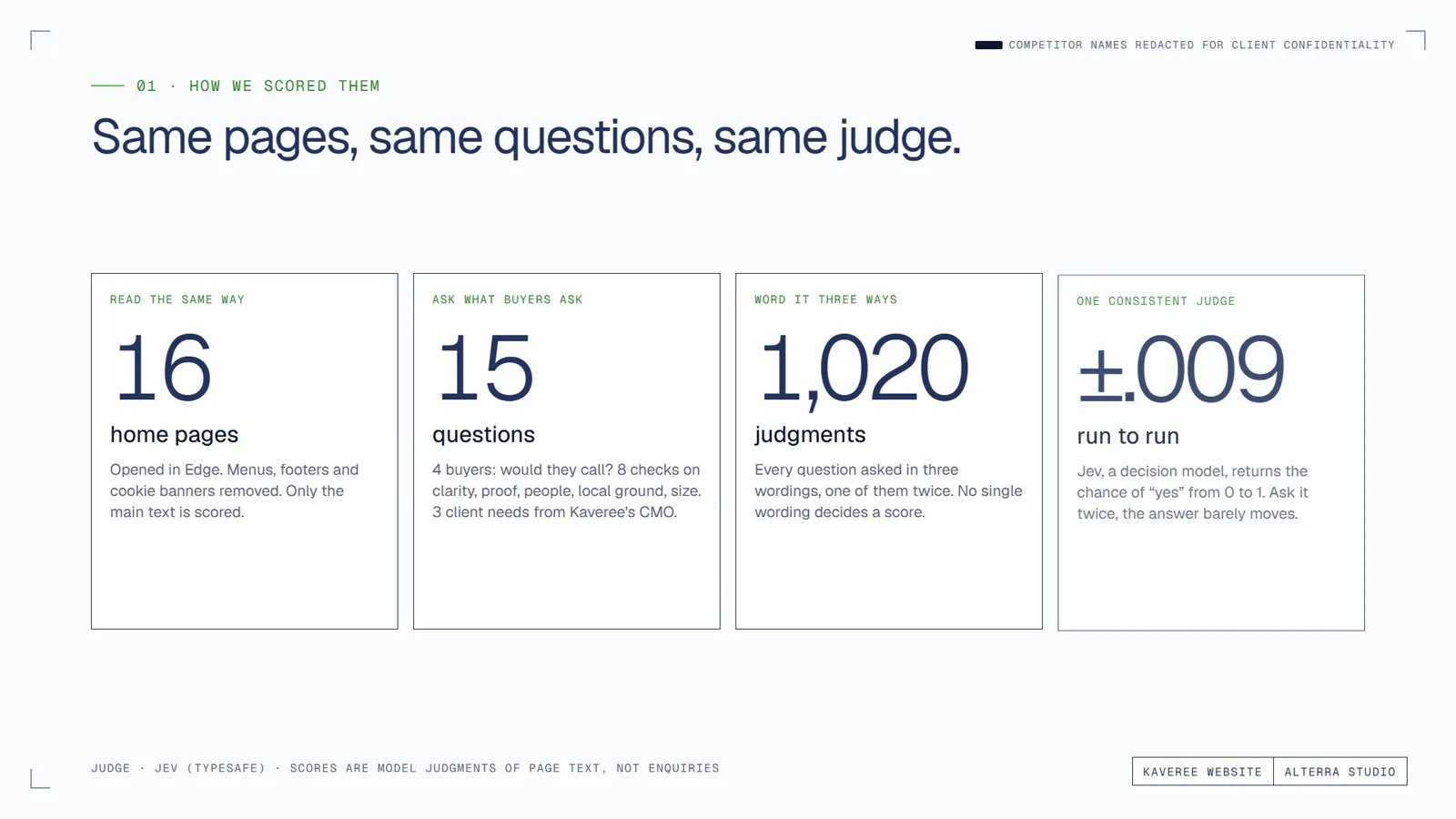
Each page was rendered in Edge with its navigation, footer and cookie banners removed, so every site was read the same way. Jev answered 15 questions per page: would four kinds of buyer contact this firm; is the page clear; does it prove its claims; is it distinctive; does it show the people, the local ground and a next step; does it look established; how broad is it; and three needs clients raise most (responsive, capacity, budget).
Every question was asked in three wordings, because a different wording moved an answer by 25 points out of 100 on average. Asking the same wording twice moved it by less than 1 point. That makes 1,020 judgments across 17 texts: 16 home pages plus the new page cut to the runner-up's length of 2,700 characters, to check that length wasn't doing the work.
- Kaveree, new site82
- New site, cut to the runner-up's length78
- Competitor (name redacted)61
- Competitor (name redacted)60
- Competitor (name redacted)56
- Competitor (name redacted)56
- Competitor (name redacted)53
- Competitor (name redacted)51
- Competitor (name redacted)51
- Competitor (name redacted)50
- Competitor (name redacted)49
- Competitor (name redacted)48
- Competitor (name redacted)46
- Competitor (name redacted)46
- Competitor (name redacted)44
- Competitor (name redacted)42
- kaveree.com, old site38
Jev (jev-latest), 2 October 2026. 90% bootstrap range: new site 78 to 86, runner-up 47 to 74. The new site ranks first under every grouping of the questions and under each wording alone. Median competitor: 50.
Where it leads, and where it trails
The lead comes from three things most engineering home pages leave out. These are also qualities the site was designed for, so part of the lead is built into the test. On looking established, the field still scores higher.
| Question | New site | Field average |
|---|---|---|
| Shows who you'll work with | 90 | 15 |
| Knows the local ground | 93 | 32 |
| Gives a clear next step | 87 | 32 |
| Looks established | 69 | 85 |
Results so far
Scores are a model's reading of each home page's text, from 0 to 100. They are not enquiries or traffic: the site had not launched as of 2 October 2026.
- Benchmark rank
- 1st of 16 home pages, under every question group and every wording
- Benchmark score
- 82 in 100 (90% range 78 to 86). Runner-up 61, median competitor 50, old kaveree.com 38: the new page scores more than double the old one
- Length-matched
- 78 in 100 when cut to the runner-up's length, still first
- Leads
- Shows who you'll work with: 90 in 100, competitors average 15. Local ground: 93 against 32. A clear next step: 87 against 32
- Trails
- Looking established: 69 in 100, competitors average 85
- Hero test
- Film band 98 in 100, full-screen takeover 70
- Accessibility
- axe WCAG A/AA clean on 40 of 40 pages
- Client review
- Kaveree's CMO reviewed every page before sign-off. Her one request was a full copy check, which we ran: 149 edits across 40 pages
- Speed
- First paint 1.0 s on emulated mobile 4G with the CPU slowed 4x
“The new templates have also reduced the time required to prepare qualifications and marketing materials for new opportunities.”
What's next
- Launch once Kaveree signs off, with every old URL redirected.
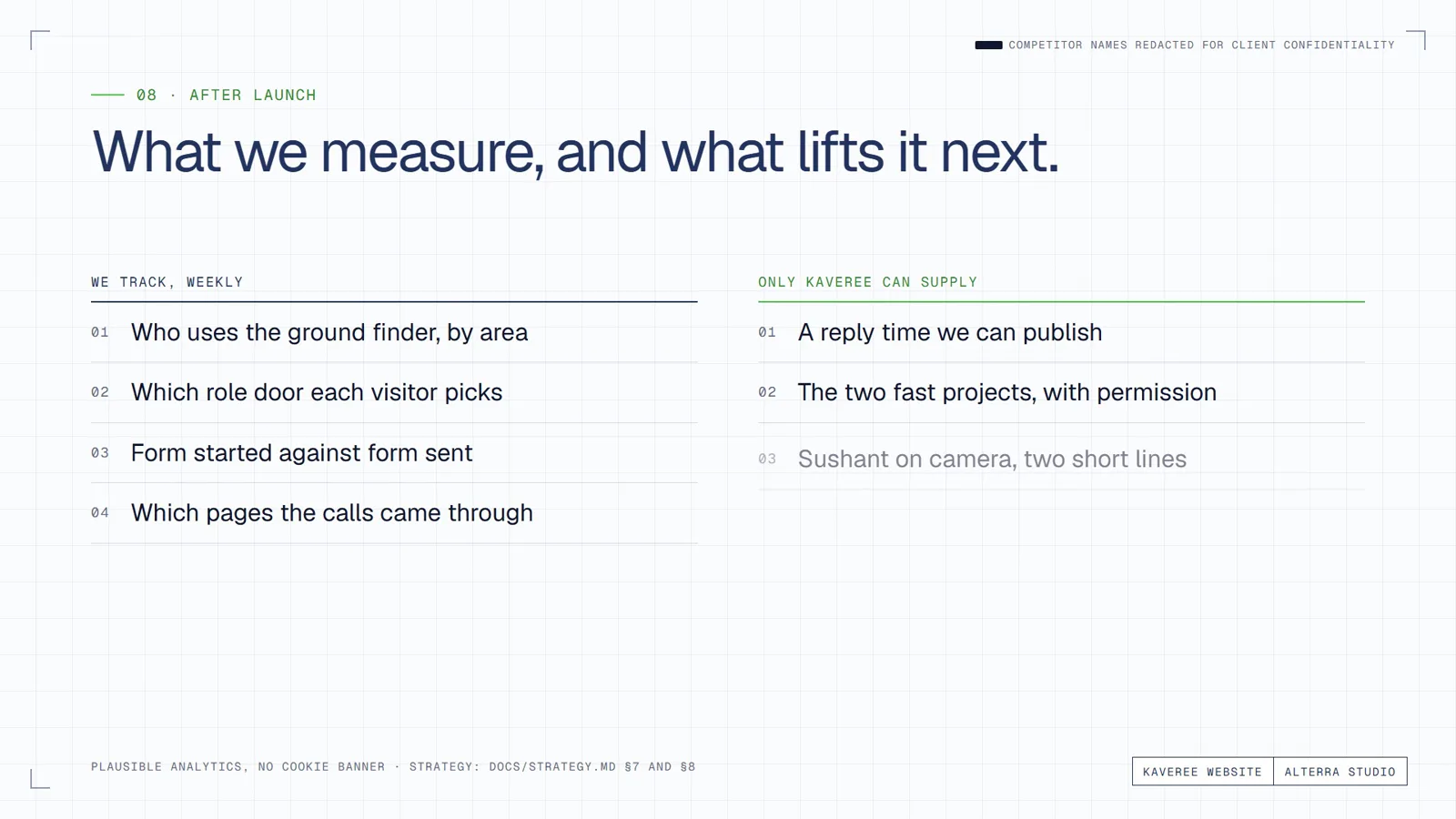
- Measure with privacy-friendly analytics: county finder picks, the borings drawing, report views, and each contact path started and submitted. Review at 90 days.
- Add Kaveree's proof: a reply-time commitment, one written case study with numbers and real field footage.
- Run the benchmark again after launch and set it beside real enquiries.
The whole case, as one film
We first made these films so Kaveree's leaders could see why each part of the site exists before they signed it off. This is the same material as the clips above, end to end.
Want your buyers' fears answered before they call? Talk to us about website design and development.
Curious how your site compares?  Run the same audit on your site →