Core competencies
- Custody past GEO. A position and its uncertainty for every object out to the Moon. In custody means under 10 km.
- Fixes from two lines of sight. One sensor gives a bearing; two far apart give a position, where their lines cross.
- Tasking in one action. The operator holds one button; Custody sends the pair of sensors with the widest angle.
- Handoff to the catalogue. The new orbit, its uncertainty and the manoeuvre go to the owner and allied watch floors.
Differentiators
Sensors between Earth and the Moon24 Witness telescopes in cislunar orbits, so the second line of sight comes from far away, not from the next site down the road.
The uncertainty is the interfaceEvery screen leads with how far off an object could be, so an old position never passes for a current one.
One timeline, two devicesThe watch-floor console and the duty officer's phone show the same object in the same state at the same moment.
The system
| Witness | 24 small optical satellites, PX-1 to PX-24, watching the space between Earth and the Moon. |
|---|---|
| Ground stations | Station North and Station South observe objects, and time laser pulses to every Witness, so each line of sight starts from a known point. |
| Custody | The watch-floor console and the duty officer's phone app, on one timeline. |
How to buy
- Briefing. Thirty minutes, unclassified, on a live object.
- Pilot. Custody on your own list of objects.
- Service. Orbit data for your catalogue, or Custody seats for your watch floor.
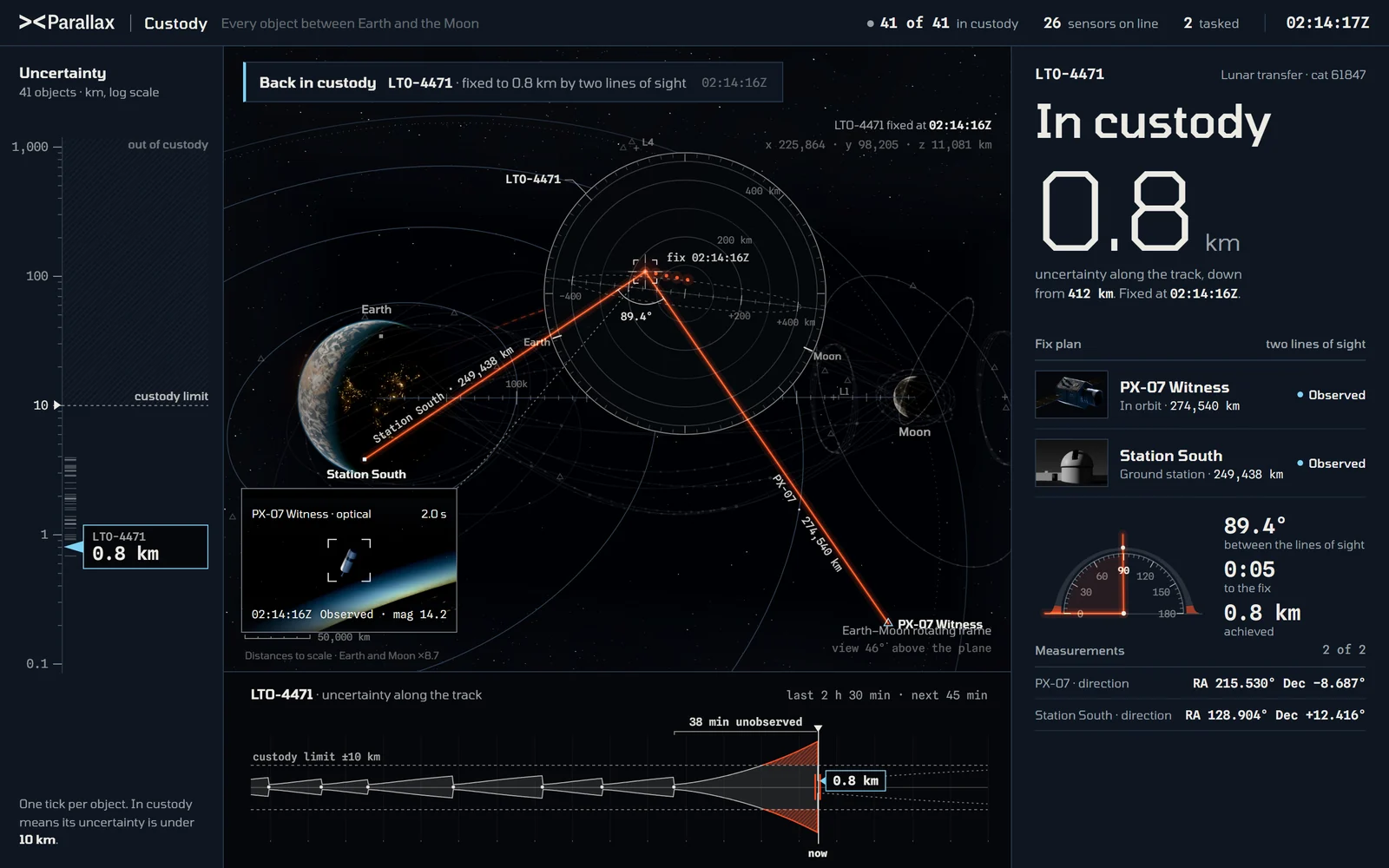
How a fix works LTO-4471, the last 2 hours, from Custody
The doubt grows while nobody watches and turns red past the 10 km custody limit. Two lines of sight at 89.4° close it to 0.8 km.
Performance demonstrated on LTO-4471
| Alert | The moment an observation misses the track: 160 km off, against a 3-sigma of 3.2 km |
|---|---|
| Drift while unobserved | 412 km along the track after 38 min |
| Fix | 0.8 km, two lines of sight at 89.4° |
| Time to fix | 0:05 from the hold to both observations |
| Coverage | Earth to the Moon, every object in the catalogue |
What the operator sees Custody at the fix